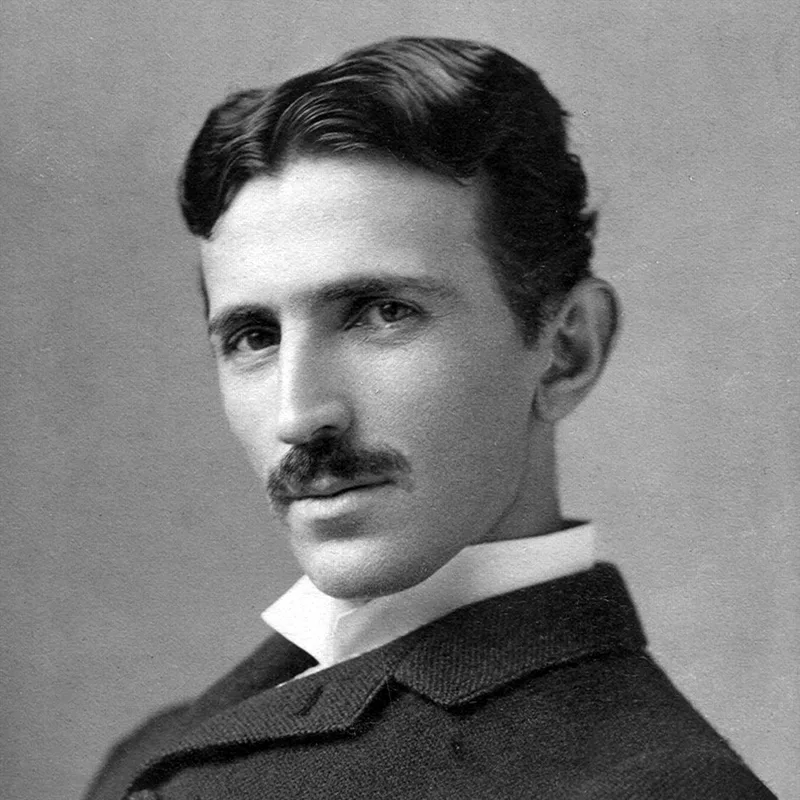
Nikola Tesla
Inventor, Electrical engineer, 1856–1943
Mechanist
What is the meaning of life?
To increase human energy through food, peace and work.
Tesla's fullest answer is his essay "The Problem of Increasing Human Energy" (Century Magazine, 1900). He treated humanity as one body in motion and asked how its energy could be raised: by food to increase the mass, peace to reduce what holds it back, and work to push it forward. He noted that these were the three words he had been taught as a child, the son of a Serbian Orthodox priest, and he praised Christianity for making work its chief command. The individual passes, he wrote, but man remains. Late in life, in 1937, he added that every person needs some ideal — religious, artistic, scientific or humanitarian — to give life significance.
-
“So we find that the three possible solutions of the great problem of increasing human energy are answered by the three words: food, peace, work. … Thus we are inspired both by Christianity and Science to do our utmost toward increasing the performance of mankind.”1
-
“Does this not prove that each of us is only part of a whole? … The individual is ephemeral, races and nations come and pass away, but man remains.”1
-
“While I am not a believer in the orthodox sense, I commend religion, first, because every individual should have some ideal — religious, artistic, scientific, or humanitarian — to give significance to his life.”2
What is the meaning of the universe?
A great machine that never began and will never end.
Tesla described the universe, and people in it, as mechanism. In My Inventions (1919) he said years of self-observation had convinced him that he was an automaton responding to the stimuli of the senses, and in 1937 he said the universe is a great machine that never came into being and never will end. On that view what we call soul or spirit is the sum of the body's workings and stops when they stop. He separated this from religion's ideals, which he respected, and set it against theological dogma, which he did not. For the stuff of the world he used Sanskrit terms from Vedanta, which he studied after meeting Swami Vivekananda in 1896: all matter comes from a primary substance, the Akasha, set in motion by Prana, the creative force, in never-ending cycles.
-
“There is no conflict between the ideal of religion and the ideal of science, but science is opposed to theological dogmas because science is founded on fact. To me, the universe is simply a great machine which never came into being and never will end. The human being is no exception to the natural order. Man, like the universe, is a machine.”2
-
“In the course of ages, mechanisms of infinite complexity are developed, but what we call "soul" or "spirit," is nothing more than the sum of the functionings of the body. When this functioning ceases, the "soul" or the "spirit" ceases likewise.”2
-
“Long ago he recognized that all perceptible matter comes from a primary substance, or a tenuity beyond conception, filling all space, the Akasha or luminiferous ether, which is acted upon by the life-giving Prana or Creative Force, calling into existence, in never ending cycles, all things and phenomena.”3