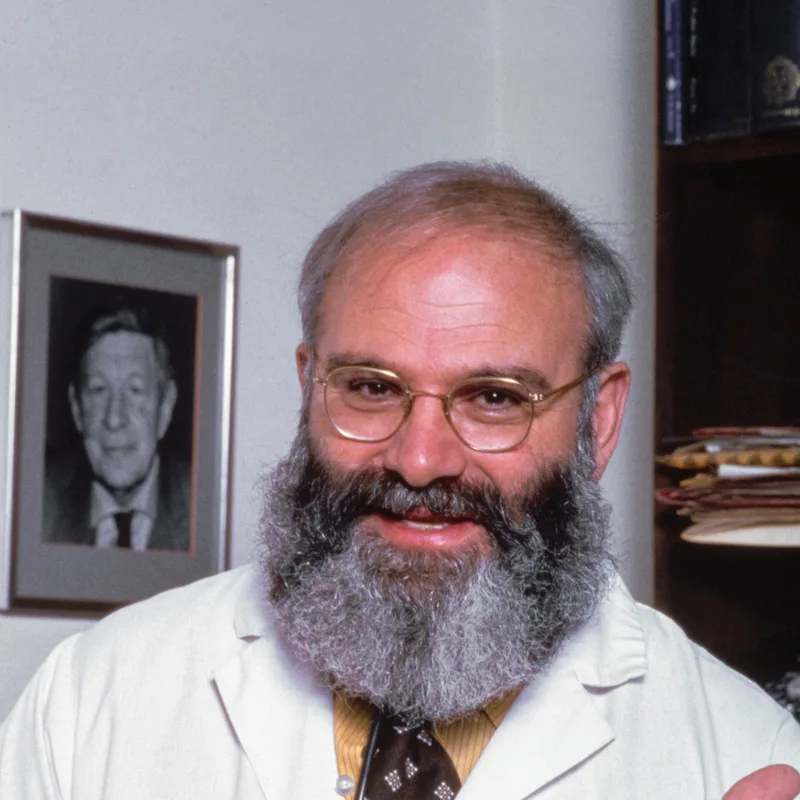
Oliver Sacks
Neurologist, Author, 1933–2015
Jewish atheist
What is the meaning of life?
Gratitude: to have been a thinking animal on this beautiful planet.
Sacks wrote his answer in the months after learning, in early 2015, that he had terminal cancer. In "My Own Life" (The New York Times, February 2015) he said his predominant feeling was gratitude: he had loved and been loved, read and travelled and thought and written, and above all had been a sentient being, a thinking animal, on this beautiful planet. The diagnosis gave him a sudden clear focus — no time for the inessential, only for his work, his friends and the people he loved. In "Sabbath", published two weeks before he died, he said his thoughts turned not to the supernatural but to what makes a good and worthwhile life, and to the idea of a seventh day on which one's work is done and one may rest.
-
“I cannot pretend I am without fear. But my predominant feeling is one of gratitude. I have loved and been loved; I have been given much and I have given something in return; I have read and traveled and thought and written. I have had an intercourse with the world, the special intercourse of writers and readers. Above all, I have been a sentient being, a thinking animal, on this beautiful planet, and that in itself has been an enormous privilege and adventure.”1
-
“I feel a sudden clear focus and perspective. There is no time for anything inessential. I must focus on myself, my work and my friends.”1
-
“When people die, they cannot be replaced. They leave holes that cannot be filled, for it is the fate — the genetic and neural fate — of every human being to be a unique individual, to find his own path, to live his own life, to die his own death.”1
-
“And now, weak, short of breath, my once-firm muscles melted away by cancer, I find my thoughts, increasingly, not on the supernatural or spiritual, but on what is meant by living a good and worthwhile life — achieving a sense of peace within oneself. I find my thoughts drifting to the Sabbath, the day of rest, the seventh day of the week, and perhaps the seventh day of one's life as well, when one can feel that one's work is done, and one may, in good conscience, rest.”2
What is the meaning of the universe?
No God; nature and deep time, where one feels at home.
Sacks lost the Orthodox Judaism of his childhood early and abruptly, in the war years at boarding school; in Uncle Tungsten (2001) he recalled a raging atheism, a fury with God for not existing and not preventing the war. He later borrowed Jonathan Miller's phrase and called himself an old Jewish atheist; he did not believe in Belief with a capital B — faith, or belief without evidence — but trusted science as a cautious way of apprehending reality. What he felt in front of the universe was not religious, but it was awe. Standing in a primeval cycad forest in 1996 he described a new time sense opening in him, immense vistas of space and time, and a sense of being at home, a companionship with the earth. He missed the rituals of Judaism all the same.
-
“I myself, traumatized at Braefield, had lost touch with, lost interest in, the religion of my childhood. I regret that I was to lose it as early and as abruptly as I did, and this feeling of sadness or nostalgia was strangely admixed with a raging atheism, a sort of fury with God for not existing, not taking care, not preventing the war, but allowing it, and all its horrors, to occur.”3
-
“I feel I'm also an old Jewish atheist, although when I said that to one friend of mine at Cornell, he said, 'I'm an older Jewish atheist'.”4
-
“But I do believe in science as a cautious method of trying to apprehend some aspects of reality which have to be grounded in... in evidence and experiment and in one's ability to make hypotheses. I feel comfortable with science. I feel very uncomfortable with... with the notion of faith.”5
-
“The primeval, the sublime, are much better words here — for they indicate realms remote from the moral or the human, realms which force us to gaze into immense vistas of space and time, where the beginnings and originations of all things lie hidden. … Standing here in the jungle, I feel part of a larger, calmer identity; I feel a profound sense of being at home, a sort of companionship with the earth.”6