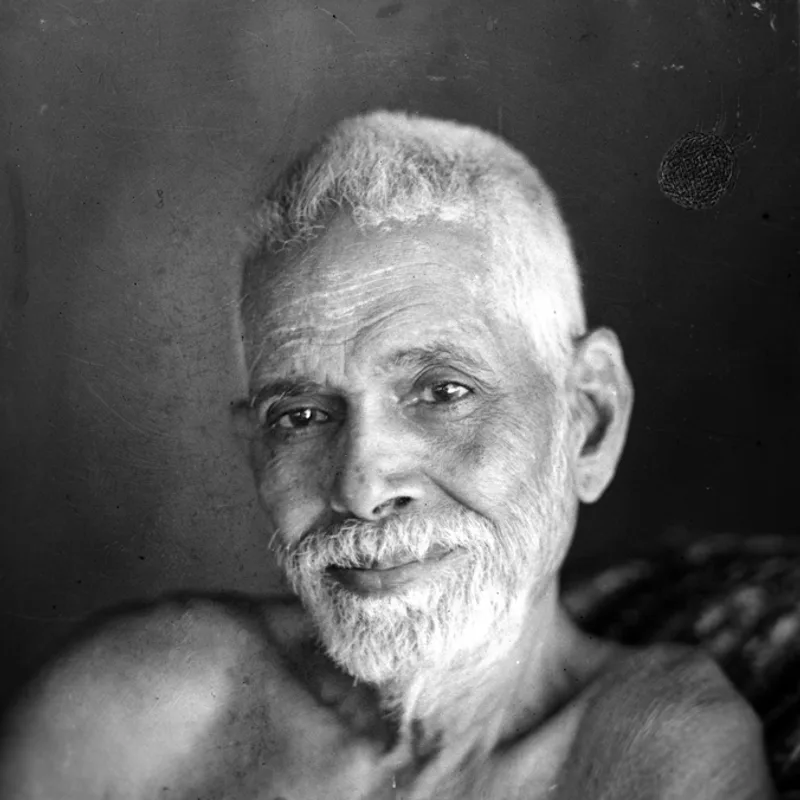
Ramana Maharshi
Sage, Spiritual teacher, 1879–1950
Advaita, self-inquiry
What is the meaning of life?
Simply be: ask 'Who am I?' until the ego falls away.
Born Venkataraman Iyer in a village in Tamil Nadu, at sixteen he was seized by a sudden fear of death; he lay down, imitated a corpse, and understood that he was not the body but the awareness that remained. Weeks later he left home for the holy mountain Arunachala at Tiruvannamalai, where he spent the remaining fifty-four years of his life and around whom an ashram grew. He taught mostly in silence and through answers to visitors, and his method was simple: ask 'Who am I?' and follow the sense of 'I' back to its source. He saw no need to become anything in particular; our duty, he said, is simply to be.
-
“Your duty is to be, and not to be this or that.”1
What is the meaning of the universe?
Only the Self is real; the world is its appearance.
Ramana's teaching is Advaita Vedanta, lived rather than argued: there is one reality, the Self, pure awareness, and the separate person who seems to face a separate world is an appearance within it. The root of the illusion is the ego, the 'I'-thought; look for it closely and it dissolves, since it has no substance of its own, and what is left is reality. He identified the Self with God, so the seeker has nowhere else to go to find God. Paul Brunton's book A Search in Secret India (1934) made him famous in the West, and he died at his ashram in 1950.
-
“Reality is simply the loss of ego.”2