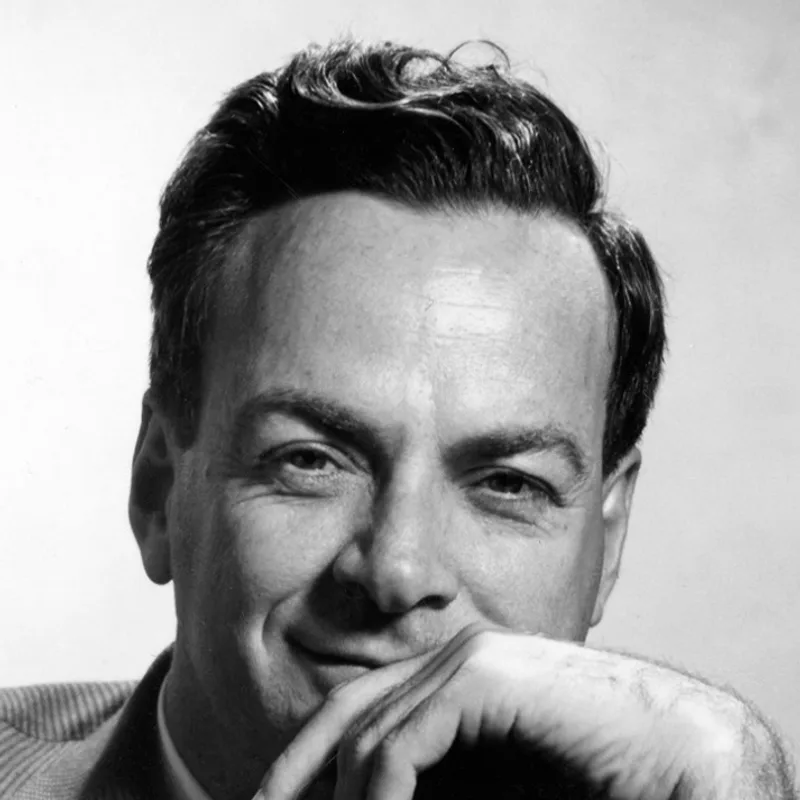
Richard Feynman
Theoretical physicist, 1918–1988
Atheist
What is the meaning of life?
You can live not knowing; there's no given purpose, and that's fine.
Feynman treated the question of purpose as one more thing he did not know, and said he was comfortable with that. In a 1981 BBC interview he explained that he could live with doubt and uncertainty, that he did not have to know an answer to "Why are we here?", and that being lost in a mysterious universe without a purpose did not frighten him. In The Value of Science (1955) he put the same point as a positive: once we admit frankly that we do not know what it all means, we have found the open channel — the freedom to doubt, question and keep learning, which he saw as science's gift to society. What he offered in place of a purpose was the pleasure of finding things out.
-
“There are many things I don't know anything about, such as whether it means anything to ask "Why are we here?" I might think about it a little bit, and if I can't figure it out then I go on to something else. But I don't have to know an answer. I don't feel frightened by not knowing things, by being lost in the mysterious universe without having any purpose — which is the way it really is, as far as I can tell. Possibly. It doesn't frighten me.”1
-
“If we take everything into account — not only what the ancients knew, but all of what we know today that they didn't know — then I think that we must frankly admit that we do not know. But, in admitting this, we have probably found the open channel.”2
-
“People search for certainty. But there is no certainty. People are terrified — how can you live and not know? It is not odd at all. You only think you know, as a matter of fact. And most of your actions are based on incomplete knowledge and you really don't know what it is all about, or what the purpose of the world is, or know a great deal of other things. It is possible to live and not know.”3
What is the meaning of the universe?
No purpose, no God; the stage is too big for the drama.
Feynman called himself an atheist, and said agnostic would be weaseling. His objection to religion was one of scale: the universe revealed by physics — its range of time and space, its planets, animals and atoms in motion — was too big to be merely a stage on which God watches humans struggle between good and evil. In The Meaning of It All, lectures given in 1963, he described contemplating the universe without man as a great adventure that ends in awe and mystery, lost at the edge in uncertainty, beside which the religious picture seemed inadequate. He did not claim that science disproved God, only that he saw no need for the idea and no reason to fear the gap it left.
-
“It doesn't seem to me that this fantastically marvelous universe, this tremendous range of time and space and different kinds of animals, and all the different planets, and all these atoms with all their motions, and so on, all this complicated thing can merely be a stage so that God can watch human beings struggle for good and evil — which is the view that religion has. The stage is too big for the drama.”4
-
“It is a great adventure to contemplate the universe, beyond man, to contemplate what it would be like without man, as it was in a great part of its long history and as it is in a great majority of places. … Well, these scientific views end in awe and mystery, lost at the edge in uncertainty, but they appear to be so deep and so impressive that the theory that it is all arranged as a stage for God to watch man's struggle for good and evil seems inadequate.”5
-
“[I call myself] an atheist. Agnostic for me would be trying to weasel out and sound a little nicer than I am about this.”6