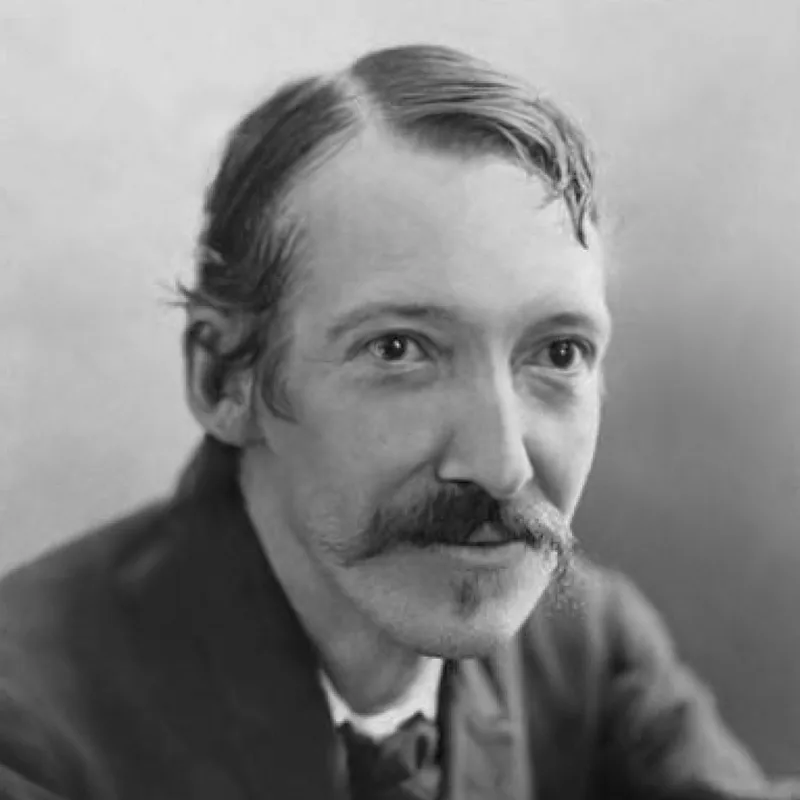
Robert Louis Stevenson
Novelist, Essayist, Poet, 1850–1894
Undogmatic believer
What is the meaning of life?
To travel hopefully; the true success is to labour.
Stevenson was ill for most of his life, with weak lungs that sent him from Scotland to France, California, the Swiss Alps and finally Samoa, where he died at forty-four; in between he wrote Treasure Island, Kidnapped and Strange Case of Dr Jekyll and Mr Hyde. In his essays he argued that happiness lies less in getting what we want than in wanting: in desires and curiosities that keep renewing themselves, so that every goal reached opens a new horizon. In “El Dorado” (1878) he concluded that to travel hopefully is better than to arrive, and that the true success is the labour itself. Ten years later, in “Pulvis et Umbra”, he added that the striving matters even though we always fall short.
What is the meaning of the universe?
A rough but noble universe where all creation strives, not in vain.
Stevenson was raised in strict Scottish Presbyterianism, and at twenty-two he told his father he no longer believed, a confession that devastated both his parents. He did not stay an unbeliever: a few years later he wrote to his father that he believed in “the God who made us all”, and at the end of his life in Samoa he wrote prayers for his household. In the essay “Pulvis et Umbra” (1888) he looked at the universe as the science of his day described it, a frightening place of whirling worlds and living things devouring one another, and found in it one consoling fact: everywhere, in people and in animals, there is a striving to do well that is never rewarded and never gives up. That, he wrote, should be enough for faith.
-
“The human race is a thing more ancient than the ten commandments; and the bones and revolutions of the Kosmos, in whose joints we are but moss and fungus, more ancient still.”2
-
“Let it be enough for faith, that the whole creation groans in mortal frailty, strives with unconquerable constancy: Surely not all in vain.”2