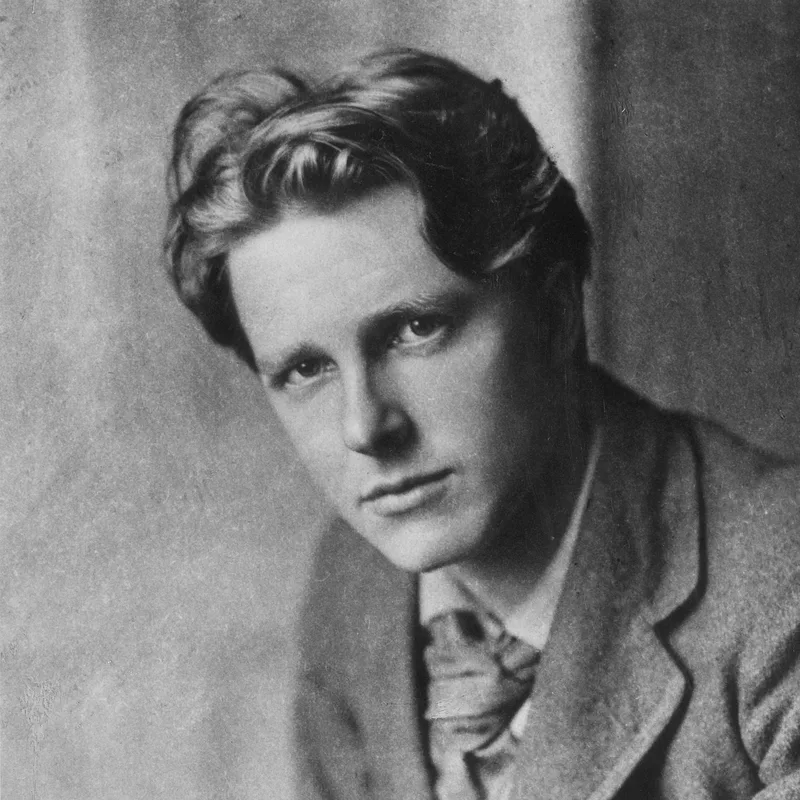
Rupert Brooke
Poet, 1887–1915
Romantic idealist
What is the meaning of life?
If I die, some corner of a foreign field is forever home.
Brooke was a golden young poet of Rugby and Cambridge whose war sonnets of 1914 caught the mood of a generation going to war. He never reached the front line in the Dardanelles: on the way to Gallipoli he died of an infected mosquito bite and was buried in an olive grove on the Greek island of Skyros. In The Soldier he imagines his own death abroad and finds meaning in having been made by the country and the people he loved.
-
“If I should die, think only this of me: / That there’s some corner of a foreign field / That is for ever England.”1
What is the meaning of the universe?
After death, the heart becomes a pulse in the eternal mind.
Brooke was no conventional believer, but The Soldier ends with a vision of what survives: the heart, purified of evil, becomes a pulse in the eternal mind, and gives back somewhere the thoughts, dreams, laughter and gentleness it received in life. The sonnet was read aloud from the pulpit of St Paul's Cathedral at Easter 1915, weeks before his death. Later poets of the war, like Wilfred Owen, answered its idealism with bitter realism.
-
“And think, this heart, all evil shed away, / A pulse in the eternal mind, no less / Gives somewhere back the thoughts by England given; / Her sights and sounds; dreams happy as her day; / And laughter, learnt of friends, and gentleness, / In hearts at peace, under an English heaven.”1