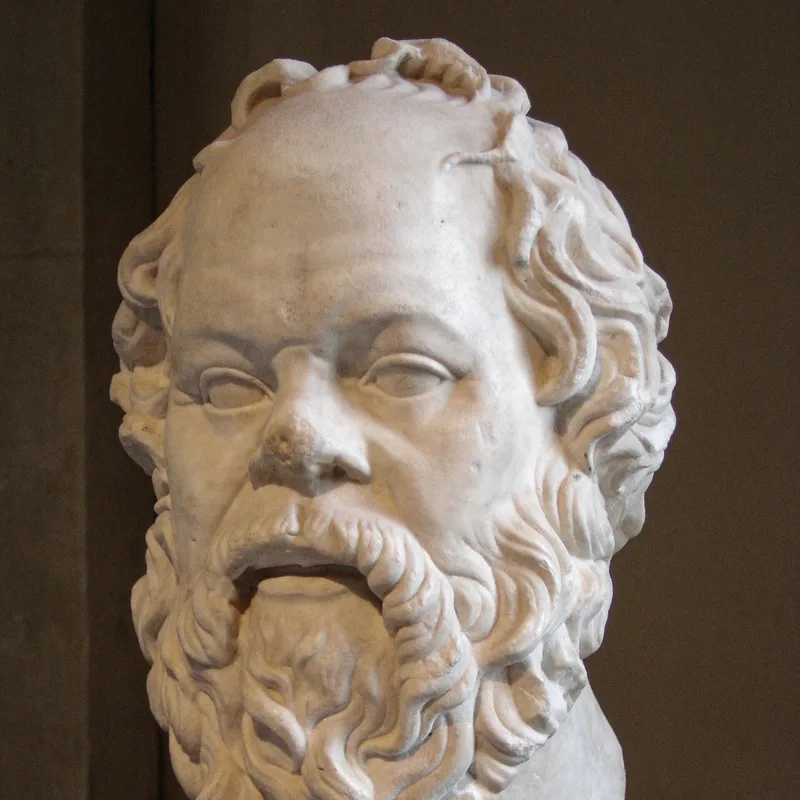
Socrates
Philosopher, c. 470 – 399 BC
Pious rationalist
What is the meaning of life?
To examine your life, and care for your soul over everything else.
Socrates wrote nothing; what we have is the Socrates of Plato and Xenophon. At his trial in 399 BC, as Plato reports it in the Apology, he described his life's work as a mission from the god at Delphi: to go about Athens persuading people to care less about money, reputation and the body and more about truth and the state of their souls. Virtue was for him a kind of knowledge, and no one does wrong knowingly. The good life was one examined every day in conversation, and he preferred death to giving that up. What mattered was not how long you lived but whether you acted rightly — and never, in Crito, doing wrong in return.
-
“If I say again that daily to discourse about virtue, and of those other things about which you hear me examining myself and others, is the greatest good of man, and that the unexamined life is not worth living, you are still less likely to believe me.”1
-
“I do nothing but go about persuading you all, old and young alike, not to take thought for your persons or your properties, but first and chiefly to care about the greatest improvement of the soul. I tell you that virtue is not given by money, but that from virtue comes money and every other good of man, public as well as private.”2
-
“There you are mistaken: a man who is good for anything ought not to calculate the chance of living or dying; he ought only to consider whether in doing anything he is doing right or wrong — acting the part of a good man or a bad.”3
-
“One should never do wrong in return, nor mistreat any man, no matter how one has been mistreated by him.”4
What is the meaning of the universe?
Good gods, an inner voice that warns, and death unknown.
Socrates took the gods for granted and told his jury he acknowledged them more than his accusers did, but his gods were not Homer's: they were wise and good and did not lie. Since childhood he had heard a daimonion, a divine sign or voice that forbade things and never commanded — the "new divinities" of the indictment against him. In Xenophon's Memorabilia he argues from the design of the body to a maker who sees and hears everything and cares for people. About what comes after death he claimed no knowledge: either nothingness, like a dreamless sleep, or a migration of the soul elsewhere, and either way nothing bad can happen to a good man. In Plato's Phaedo he argues at length that the soul is immortal; many scholars read that as Plato's view more than his.
-
“You have heard me speak at sundry times and in divers places of an oracle or sign which comes to me, and is the divinity which Meletus ridicules in the indictment. This sign, which is a kind of voice, first began to come to me when I was a child; it always forbids but never commands me to do anything which I am going to do.”5
-
“For the fear of death is indeed the pretence of wisdom, and not real wisdom, being a pretence of knowing the unknown; and no one knows whether death, which men in their fear apprehend to be the greatest evil, may not be the greatest good.”6
-
“Let us reflect in another way, and we shall see that there is great reason to hope that death is a good; for one of two things—either death is a state of nothingness and utter unconsciousness, or, as men say, there is a change and migration of the soul from this world to another. Now if you suppose that there is no consciousness, but a sleep like the sleep of him who is undisturbed even by dreams, death will be an unspeakable gain.”7
-
“Wherefore, O judges, be of good cheer about death, and know of a certainty, that no evil can happen to a good man, neither in life nor after death. He and his are not neglected by the gods; nor has my own approaching end happened by mere chance.”8