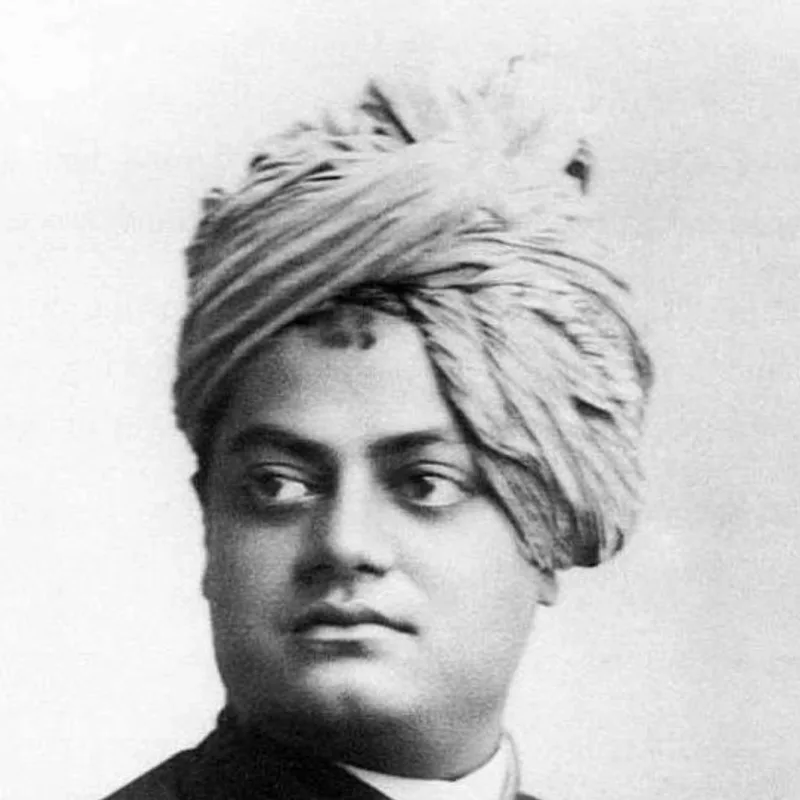
Swami Vivekananda
Hindu monk, Vedanta teacher, 1863–1902
Advaita Vedanta
What is the meaning of life?
To manifest the divinity within, and live for others.
Vivekananda, born Narendranath Datta in Calcutta and a disciple of the mystic Ramakrishna, taught Vedanta as a practical religion. Its goal, in the summary he placed at the head of Raja-Yoga (1896), is to manifest the divinity already present in every soul and so be free, whether by work, worship, psychic control or philosophy; doctrines, rituals, books and temples are secondary details. At the Parliament of the World's Religions in Chicago in 1893 he said the whole religion of the Hindu is centred in realisation: man is to become divine by realising the divine. He joined this to service. Writing from Chicago to the Maharaja of Mysore in 1894, about a plan to educate India's poor, he said that they alone live who live for others.
-
“Each soul is potentially divine. The goal is to manifest this Divinity within by controlling nature, external and internal. Do this either by work, or worship, or psychic control, or philosophy — by one, or more, or all of these — and be free. This is the whole of religion. Doctrines, or dogmas, or rituals, or books, or temples, or forms, are but secondary details.”1
-
“My noble Prince, this life is short, the vanities of the world are transient, but they alone live who live for others, the rest are more dead than alive.”2
-
“The Vedas teach that the soul is divine, only held in the bondage of matter; perfection will be reached when this bond will burst, and the word they use for it is therefore, Mukti — freedom, freedom from the bonds of imperfection, freedom from death and misery.”3
What is the meaning of the universe?
One infinite principle, not a person; all of us its embodiments.
His universe is that of Vedanta. In his paper on Hinduism at Chicago in 1893 he said the Vedas teach that creation is without beginning or end: creation and creator are two parallel lines, and God is the ever-active providence by whose power systems after systems evolve out of chaos, run for a time and are destroyed. Behind the many he saw one reality — religion, like every science, seeks unity, and would be complete when it found the one life in a universe of death, the only Soul of which all souls are manifestations. Writing from London in 1896 he put it more plainly: the eternal, infinite, omnipresent and omniscient is a principle, not a person, and all of us are its embodiments, one in essence already.
-
“If I may be allowed to use a simile, creation and creator are two lines, without beginning and without end, running parallel to each other. God is the ever active providence, by whose power systems after systems are being evolved out of chaos, made to run for a time and again destroyed.”3
-
“Physics would stop when it would be able to fulfill its services in discovering one energy of which all others are but manifestations, and the science of religion become perfect when it would discover Him who is the one life in a universe of death, Him who is the constant basis of an ever-changing world. One who is the only Soul of which all souls are but delusive manifestations.”3
-
“The eternal, the infinite, the omnipresent, the omniscient is a principle, not a person. You, I, and everyone are but embodiments of that principle, and the more of this infinite principle is embodied in a person, the greater is he, and all in the end will be the perfect embodiment of that and thus all will be one as they are now essentially.”4