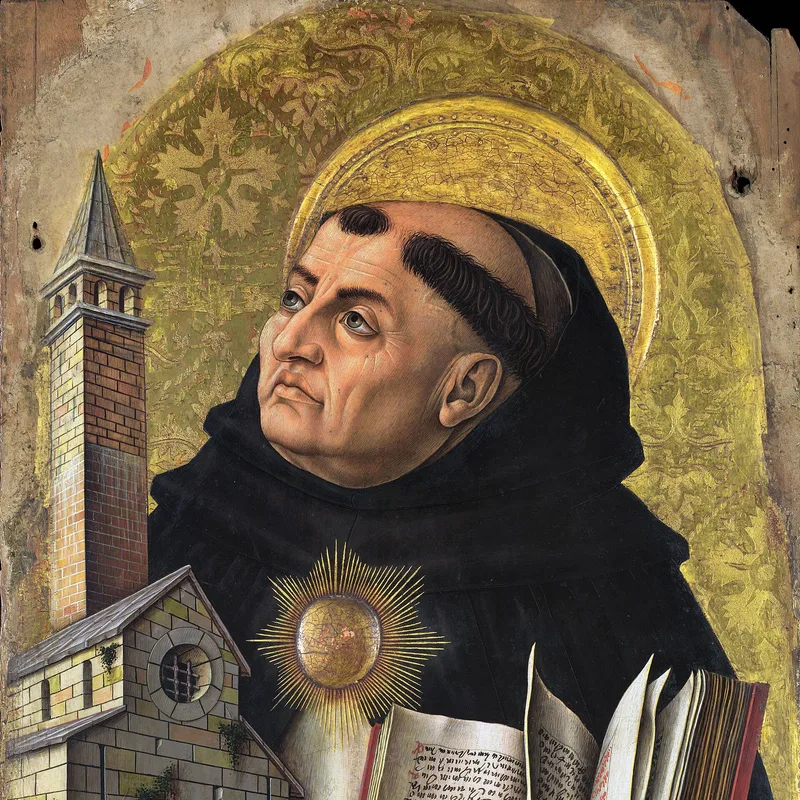
Thomas Aquinas
Dominican friar, Theologian, Philosopher, c. 1225 – 1274
Christian Aristotelian
What is the meaning of life?
To know God: perfect happiness is the vision of his essence.
Aquinas was a Dominican friar who taught in Paris and Italy and tried to bring Aristotle's philosophy together with Christian teaching. Every human act aims at an end, and the last end that everyone wants is happiness; but wealth, honours, fame, power, bodily goods and pleasure cannot supply it, because happiness must leave nothing more to be desired, and only God, the universal good, can satisfy the will. The intellect, once it knows that things have a cause, wants to know what that cause is — a desire that begins in wonder — and it comes to rest only in seeing God's essence, the beatific vision. That is not possible in this life, where only a partial share of happiness can be had; perfect happiness is for the life to come.
-
“It is impossible for any created good to constitute man's happiness. For happiness is the perfect good, which lulls the appetite altogether; else it would not be the last end, if something yet remained to be desired. … Hence it is evident that naught can lull man's will, save the universal good. This is to be found, not in any creature, but in God alone; because every creature has goodness by participation.”1
-
“Nevertheless it may be manifestly shown that the end of every subsistent intelligence, even the lowest, is to understand God. … Everything most of all desires its own last end. But the human mind is moved to more desire and love and delight over the knowledge of divine things, little as it can discern about them, than over the perfect knowledge that it has of the lowest things.”2
-
“Final and perfect happiness can consist in nothing else than the vision of the Divine Essence. … Consequently, for perfect happiness the intellect needs to reach the very Essence of the First Cause. And thus it will have its perfection through union with God as with that object, in which alone man's happiness consists.”3
-
“A certain participation of Happiness can be had in this life: but perfect and true Happiness cannot be had in this life.”4
What is the meaning of the universe?
God, being itself: a first cause that reason can reach.
Aquinas held that reason, starting from the world, can show that God exists, and the Summa Theologiae (1265–1274) gives five ways: from motion to a first mover, from causes to a first cause, from things that might not have existed to a necessary being, from degrees of goodness and truth to a highest being, and from the order of nature to an intelligence directing it. God is subsisting being itself; everything else has being only by sharing in it, and is caused by him. Reason cannot prove, though, that the world had a beginning: Aquinas believed it did, but held this by faith alone. In December 1273, after what was reported as a mystical experience during Mass, he stopped writing and left the Summa unfinished, telling his companion Reginald that all he had written seemed like straw.
-
“The existence of God can be proved in five ways. The first and more manifest way is the argument from motion. … Therefore it is necessary to arrive at a first mover, put in motion by no other; and this everyone understands to be God.”5
-
“We see that things which lack intelligence, such as natural bodies, act for an end … Now whatever lacks intelligence cannot move towards an end, unless it be directed by some being endowed with knowledge and intelligence; as the arrow is shot to its mark by the archer. Therefore some intelligent being exists by whom all natural things are directed to their end; and this being we call God.”6
-
“Now it has been shown above … that God is the essentially self-subsisting Being … Therefore all beings apart from God are not their own being, but are beings by participation. Therefore it must be that all things which are diversified by the diverse participation of being, so as to be more or less perfect, are caused by one First Being, Who possesses being most perfectly.”7
-
“By faith alone do we hold, and by no demonstration can it be proved, that the world did not always exist.”8