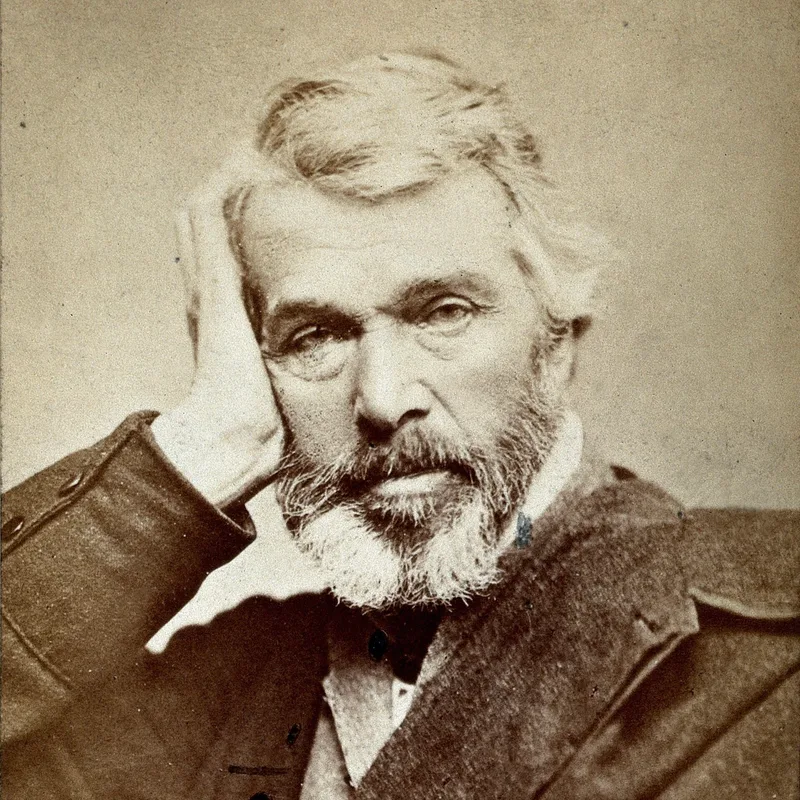
Thomas Carlyle
Historian, Essayist, 1795–1881
Believer beyond the creeds
What is the meaning of life?
Blessed is he who has found his work; ask no other blessedness.
Carlyle, the son of a Scottish stonemason, was meant for the ministry but lost his belief in Christian doctrine as a young man and went through years of misery before he found a way out. He told the story through Teufelsdröckh, the imaginary German professor of Sartor Resartus (1833–34), who passes from the “Everlasting No” through the “Centre of Indifference” to the “Everlasting Yea”: life is hemmed in by necessity, yet its meaning is freedom and voluntary force, and the cure for despair is not pleasure but work. In Past and Present (1843) he said it in his own voice: blessed is he who has found his work, for he has a life-purpose. His later worship of strong men, his contempt for democracy and his racist 1849 essay on the “Negro Question” have aged far worse.
-
“Our Life is compassed round with Necessity; yet is the meaning of Life itself no other than Freedom, than Voluntary Force: thus have we a warfare; in the beginning, especially, a hard-fought battle.”1
-
“Blessed is he who has found his work; let him ask no other blessedness. He has a work, a life-purpose; he has found it, and will follow it!”2
What is the meaning of the universe?
The Universe is not dead, but godlike, and my Father's!
Carlyle could no longer believe in miracles or creeds, but he refused the dead, mechanical universe of the materialists just as firmly. In Sartor Resartus nature itself is the true miracle, time and space are only the garments of a deeper reality, and the world is, in Goethe's image, the living garment of God. The turning point of Teufelsdröckh's crisis comes when he sees that the universe is not dead and demoniacal, a charnel-house with spectres, but godlike, and his Father's. The Everlasting Yea, in which all contradiction is solved, is simply: love not pleasure; love God.