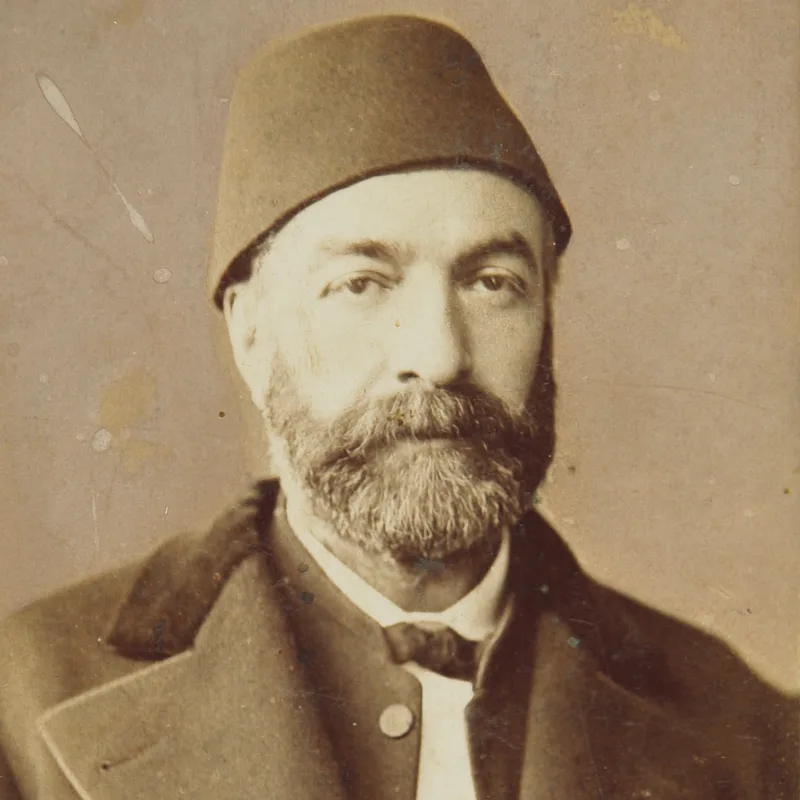
Ziya Pasha
Poet, Statesman, 1829–1880
Muslim, troubled by justice
What is the meaning of life?
A person's mirror is their work; words count for nothing.
Ziya Paşa was an Ottoman official and poet and one of the Young Ottomans who demanded a constitution in the 1860s; he fled to Europe in 1867, published the opposition paper Hürriyet in London and Geneva, and after his return governed several provinces until his death in Adana. His Terkîb-i Bend, written in Geneva in 1870 on the model of a poem by Bağdatlı Rûhî, became one of the most quoted poems in Turkish: generations learned from it that a person's mirror is their work, not their words, and that the rank of a mind shows in what it makes. Honesty, the poem says, becomes a human being even when it meets with loathing, for God himself is the helper of the honest.
What is the meaning of the universe?
Every atom bears witness to God; yet when will His justice come?
Ziya Paşa's poems are those of a believer who could not stop asking questions. In his Terci-i Bend, written in 1859 while he was a secretary at the palace, the universe is a strange school in which every image is a sign from a book of hidden knowledge, but also a mill turning on disaster, in which man is a wandering grain; certainty, he wrote, is beyond human reach, and to reason every belief is a matter of the unseen. The third stanza of the later Terkîb-i Bend praises a God whose power has no beginning and no end, to whose oneness every atom bears witness, and then asks Him when His justice will bring the tyrants to dust, while the sighs of the oppressed rise to the heavens.
-
“This workshop of creation is a wondrous school; / Every image in it is a sign from a book of hidden knowledge. / … / Man has no means of gaining certainty; / To reason, every belief is a matter of the unseen.”2
-
“O You whose power has no beginning and no end, / It is impossible to grasp Your attributes as they truly are. / Everything bears fair witness to Your existence; / Every atom testifies to Your oneness. / … / When will Your justice bring the tyrants to dust? / The sighs of the oppressed are rising to the heavens.”1