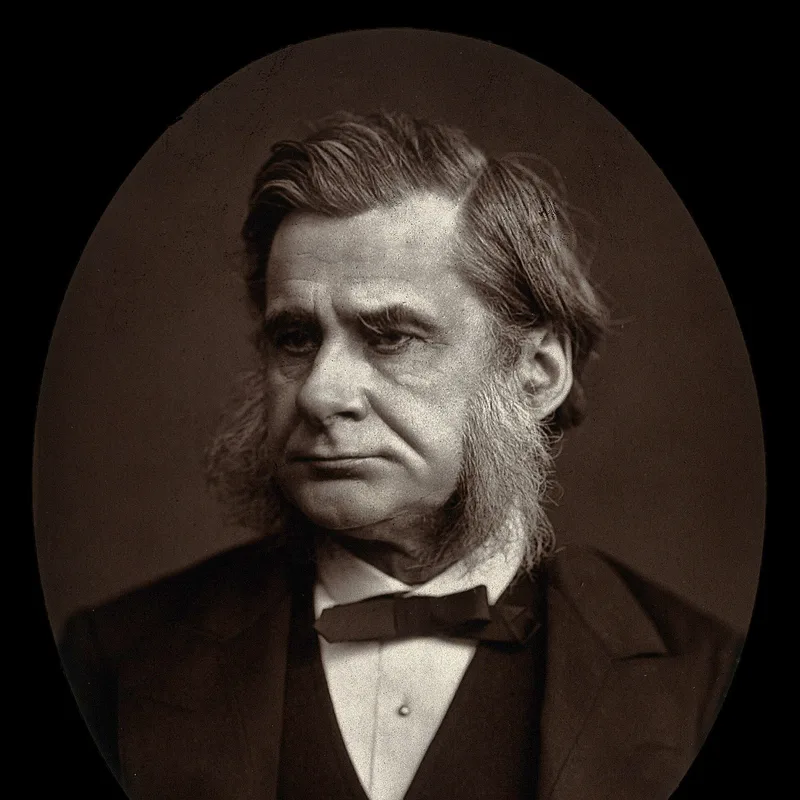
Thomas Henry Huxley
Biologist, Anatomist, Educator, 1825–1895
Agnostic
What is the meaning of life?
Action, not knowledge, is life's end; follow the facts humbly.
Huxley, a largely self-taught anatomist, became the most forceful public defender of Darwin's theory, which earned him the nickname Darwin's Bulldog. He spent much of his life campaigning for science education for working people and children, and he valued knowledge as a guide to action. When his young son died in 1860, the clergyman and novelist Charles Kingsley wrote to comfort him with the hope of immortality. Huxley answered that he could only follow the evidence, as humbly as a child, and that this had brought him his own kind of peace.
What is the meaning of the universe?
Some questions are insoluble; claim no knowledge you do not have.
Huxley coined the word agnostic in 1869, at a meeting of the Metaphysical Society, to describe his position among believers, atheists and philosophers who all claimed to know the answer. He was not sure that there was no God and no life after death; he was sure only that neither he nor anyone else had the evidence to say. Agnosticism, he insisted, was not a creed but a method: follow reason as far as it goes, and do not pretend that conclusions are certain when they have not been demonstrated.
-
“So I took thought, and invented what I conceived to be the appropriate title of “agnostic.” It came into my head as suggestively antithetic to the “gnostic” of Church history, who professed to know so much about the very things of which I was ignorant.”3