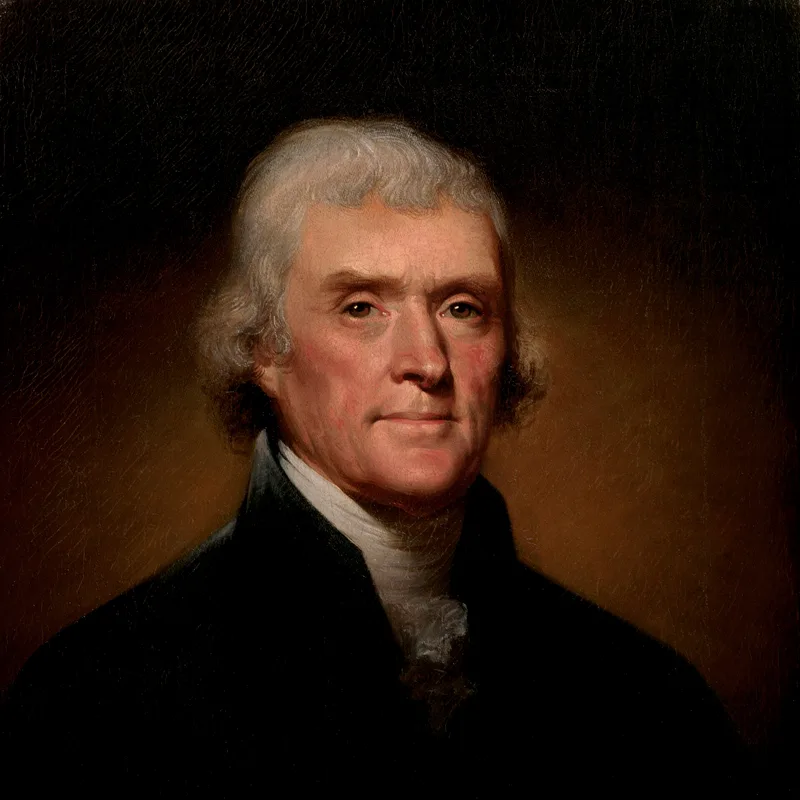
Thomas Jefferson
President of the United States, Author of the Declaration of Independence, 1743–1826
Deist
What is the meaning of life?
Happiness through virtue, as Epicurus taught; be just, be true.
Jefferson wrote the Declaration of Independence, with its pursuit of happiness, and in old age told a friend that he too was an Epicurean: happiness is the aim of life and virtue its foundation. He admired the moral teaching of Jesus above any other and cut his own version of the Gospels out of the New Testament, leaving out the miracles. His advice in 1825 to a boy named after him combined both: adore God, love your neighbour, be just and true, and do not complain about Providence.
-
“As you say of yourself, I too am an Epicurean. I consider the genuine (not the imputed) doctrines of Epicurus as containing every thing rational in moral philosophy which Greece and Rome have left us.”1
-
“Adore God. Reverence and cherish your parents. Love your neighbor as yourself, and your country more than yourself. Be just. Be true. Murmur not at the ways of Providence. So shall the life, into which you have entered, be the portal to one of eternal and ineffable bliss.”2
What is the meaning of the universe?
A Creator known by reason and design, not by revelation.
Jefferson's God was the creator known by reason from the order of nature, not through revelation or miracles. Looking at the heavens, the earth and living things, he told John Adams in 1823, the mind cannot help feeling the evidence of design, skill and power. In 1787 he had urged his nephew Peter Carr to question even the existence of God, since a God would prefer honest reason to fear. He rejected the Trinity, and hoped that Unitarianism would become the general religion of the United States.
-
“I hold (without appeal to revelation), that when we take a view of the universe, in its parts, general or particular, it is impossible for the human mind not to perceive and feel a conviction of design, consummate skill, and indefinite power in every atom of its composition.”3
-
“Question with boldness even the existence of a god; because, if there be one, he must more approve the homage of reason, than that of blindfolded fear.”4