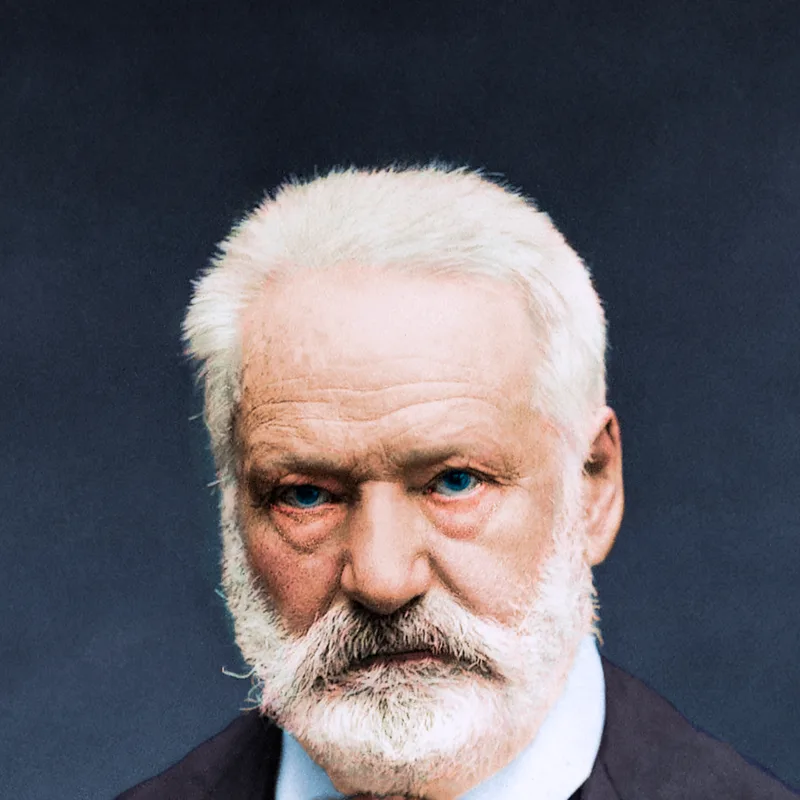
Victor Hugo
Novelist, Poet, Playwright, 1802–1885
Anticlerical theist
What is the meaning of life?
To be loved, even in spite of oneself, is life's supreme happiness.
Hugo, the leading figure of French Romanticism, spent nineteen years in exile on the Channel Islands for opposing Napoleon III, and finished Les Misérables there. The novel is a story of redemption: a convict transformed by a bishop's mercy spends the rest of his life repaying it in love and care for others. In one of its many digressions Hugo calls a blind man who is loved the most fortunate of men, because the supreme happiness of life is to know oneself loved. Love, mercy and conscience are the forces that move his characters toward the good.
-
“The supreme happiness of life consists in the conviction that one is loved; loved for one's own sake—let us say rather, loved in spite of one's self”1
What is the meaning of the universe?
God is the will of the infinite; to deny him is nihilism.
Hugo was raised a Catholic and turned against the Church, but never against God. In Les Misérables he breaks off the story to argue that the infinite exists and has a will, which is God, and that denying it leads straight to nihilism. During his exile he took part in séances and wrote at length about the soul's survival after death. His will asked to be carried to the cemetery in a pauper's hearse, and refused the funeral orations of every church while asking for the prayer of every soul.
-
“To deny the will of the infinite, that is to say, God, is impossible on any other conditions than a denial of the infinite. We have demonstrated this. The negation of the infinite leads straight to nihilism.”2
-
“I leave 50,000 francs to the poor. I wish to be buried in their hearse. I refuse [funeral] orations from all Churches. I ask [for] a prayer to all souls. I believe in God.”3