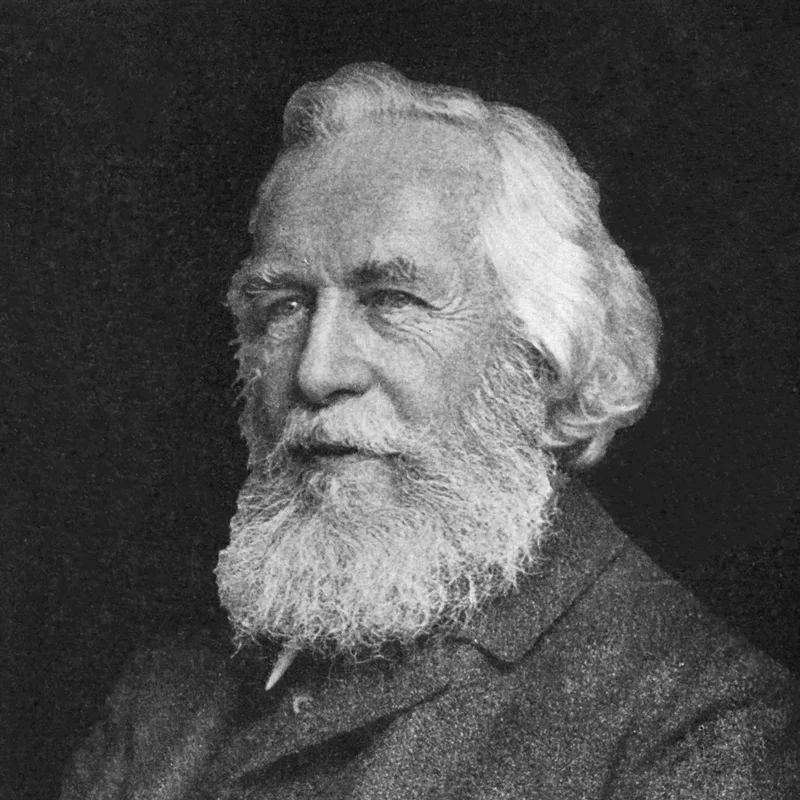
Ernst Haeckel
Zoologist, Naturalist, Artist, 1834–1919
Monist
What is the meaning of life?
Nature is the church; its creed is the good, true and beautiful.
Haeckel was a German zoologist who named thousands of species, coined the word “ecology”, drew celebrated plates of radiolarians and jellyfish in Art Forms in Nature, and became Darwin's most energetic champion in Germany. His bestseller The Riddle of the Universe (1899) offered a monist religion in place of Christianity, whose worship would be of the good, the true and the beautiful. Its church, he wrote, is the whole of nature. Some of his ideas, including racial hierarchies, were later taken up by racist and eugenic movements.
-
“…wherever he turns his gaze, to the whole universe or to any single part of it, he finds, indeed, the grim “struggle for life,” but by its side are ever “the good, the true, and the beautiful”; his church is commensurate with the whole of glorious nature.”1
What is the meaning of the universe?
God is identical with nature; pantheism is the scientist's view.
Haeckel's monism holds that matter and energy, body and mind, are one substance governed by one law, which he called the law of substance. There is no God outside the world who creates it and steers it from without. If the word God is used at all, it can only mean nature itself, the force and energy at work within the world. Pantheism, he concluded, is the world-system of the modern scientist.
-
“…in theism God is opposed to nature as an extramundane being, as creating and sustaining the world, and acting upon it from without, while in pantheism God, as an intramundane being, is everywhere identical with nature itself, and is operative within the world as “force” or “energy.” The latter view alone is compatible with our supreme law—the law of substance. It follows necessarily that pantheism is the world-system of the modern scientist.”2