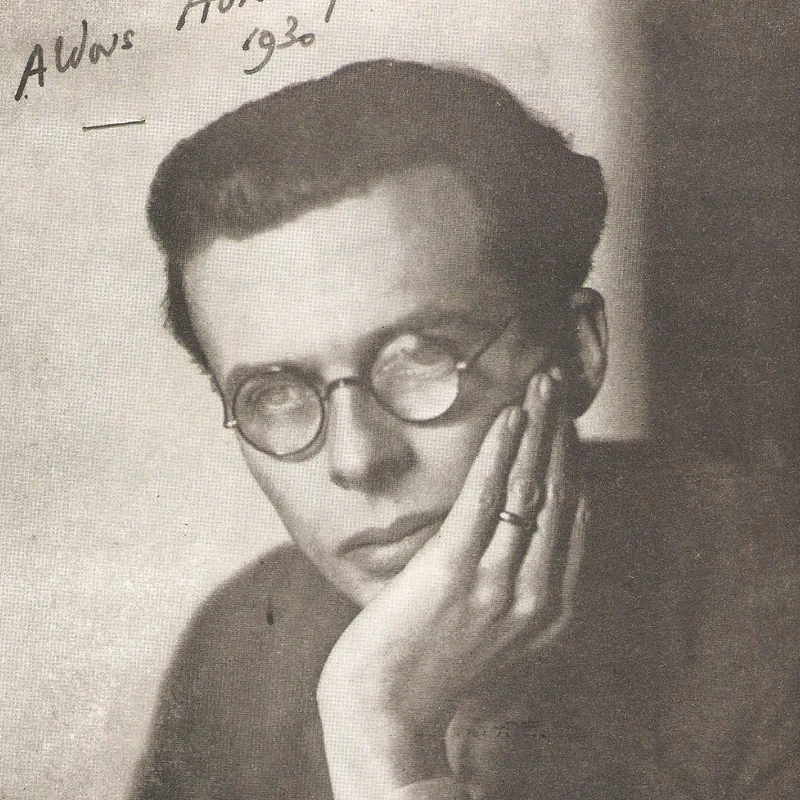
Aldous Huxley
Novelist, Essayist, 1894–1963
Perennialist (Vedanta)
What is the meaning of life?
Unitive knowledge of the divine Ground; less self, more God.
Huxley's mature answer is the one he found in the mystics of every tradition: the final end of human life is unitive knowledge of the Godhead, the divine Ground of all being. He set it out in 1944, in a short essay he called a minimum working hypothesis and in his introduction to Swami Prabhavananda and Christopher Isherwood's translation of the Bhagavad Gita, and then at length in The Perennial Philosophy (1945), an anthology of mystical writings with his own commentary. On this view contemplation is the end and action the means, there is a Way that has to be followed, and the obstacle is the self: the more there is of self, the less there is of God. He did not treat this as a private matter; in the same years he campaigned as a pacifist and wrote against what he called the organized lovelessness of modern economic and social life.
-
“That it is possible for human beings to love, know and, from virtually, to become actually identical with the divine Ground. That to achieve this unitive knowledge of the Godhead is the final end and purpose of human existence. That there is a Law or Dharma which must be obeyed, a Tao or Way which must be followed, if men are to achieve their final end.”1
-
“In regard to man's final end, all the higher religions are in complete agreement. The purpose of human life is the discovery of Truth, the unitive knowledge of the Godhead. The degree to which this unitive knowledge is achieved here on earth determines the degree to which it will be enjoyed in the posthumous state. Contemplation of truth is the end, action the means.”2
-
“'Our kingdom go' is the necessary and unavoidable corollary of 'Thy kingdom come.' For the more there is of self, the less there is of God.”3
What is the meaning of the universe?
A divine Ground behind all things, knowable by direct experience.
Huxley grew up among scientists and agnostics — his grandfather Thomas Henry Huxley coined the word agnostic — and in the 1920s he was sceptical of religion and poked fun at mysticism in his novels. In Ends and Means (1937) he looked back on that period and admitted that the philosophy of meaninglessness had been, for him and his contemporaries, an instrument of liberation from a political system and a sexual morality; the belief that the world is meaningless, he now argued, rests on the error of mistaking the world of science, from which meaning has been deliberately excluded, for ultimate reality. Through his friend Gerald Heard and the Vedanta Society of Southern California, with which he was associated from 1939 until his death, he came to hold that there is a Godhead or Ground, transcendent and immanent, that can be known directly. He never joined a church, and for much of his life still called himself an agnostic. In The Doors of Perception (1954) he described seeing, under mescaline, the divine source of all existence in a bunch of flowers.
-
“For those of us who are not congenitally the members of an organized church, who have found that humanism and nature-worship are not enough … the minimum working hypothesis would seem to run to about this: That there is a Godhead, Ground, Brahman, Clear Light of the Void, which is the unmanifested principle of all manifestations. That the Ground is at once transcendent and immanent.”1
-
“Our conviction that the world is meaningless is due … in part to a genuine intellectual error — the error of identifying the world of science, a world from which all meaning has deliberately been excluded, with ultimate reality.”4
-
“For myself as, no doubt, for most of my contemporaries, the philosophy of meaninglessness was essentially an instrument of liberation. The liberation we desired was simultaneously liberation from a certain political and economic system and liberation from a certain system of morality.”4
-
“… what rose and iris and carnation so intensely signified was nothing more, and nothing less, than what they were — a transience that was yet eternal life, a perpetual perishing that was at the same time pure Being, a bundle of minute, unique particulars in which, by some unspeakable and yet self-evident paradox, was to be seen the divine source of all existence.”5