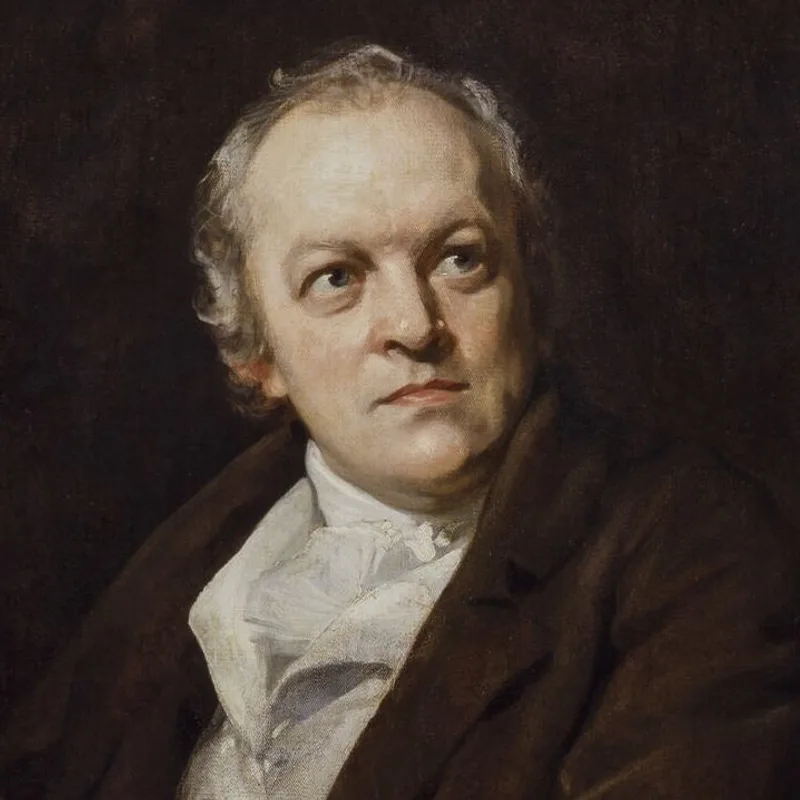
William Blake
Poet, Painter, Printmaker, 1757–1827
Visionary Christian
What is the meaning of life?
Energy is eternal delight; joy and woe are woven together.
Blake spent his life in London as an engraver, printing and hand-colouring his own illuminated books, and was dismissed by many in his lifetime as eccentric or mad. In The Marriage of Heaven and Hell (c. 1790–93) he turned conventional morality upside down: the energy and desire that preachers called evil were, to him, the source of life, while reason that only restrains them is their outer limit. He did not expect a life without sorrow. In “Auguries of Innocence” joy and woe are woven together, and knowing this is what lets a person go safely through the world.
What is the meaning of the universe?
Cleanse perception, and everything appears as it is: infinite.
Blake was a Christian of his own kind: he revered Jesus, scorned the churches and the distant God of the philosophers, and said he had seen angels and spirits since childhood. He believed the infinite is not far away but hidden by narrow perception, so that a cleansed eye could see eternity in ordinary things. “Auguries of Innocence”, written around 1803 and published only in 1863, opens with a world in a grain of sand and a heaven in a wild flower. For Blake, imagination was not mere fancy but the faculty through which eternity, and God, are seen.
-
“If the doors of perception were cleansed everything would appear to man as it is, infinite. For man has closed himself up, till he sees all things through narrow chinks of his cavern.”1
-
“To see a World in a Grain of Sand / And a Heaven in a Wild Flower / Hold Infinity in the palm of your hand / And Eternity in an hour”2