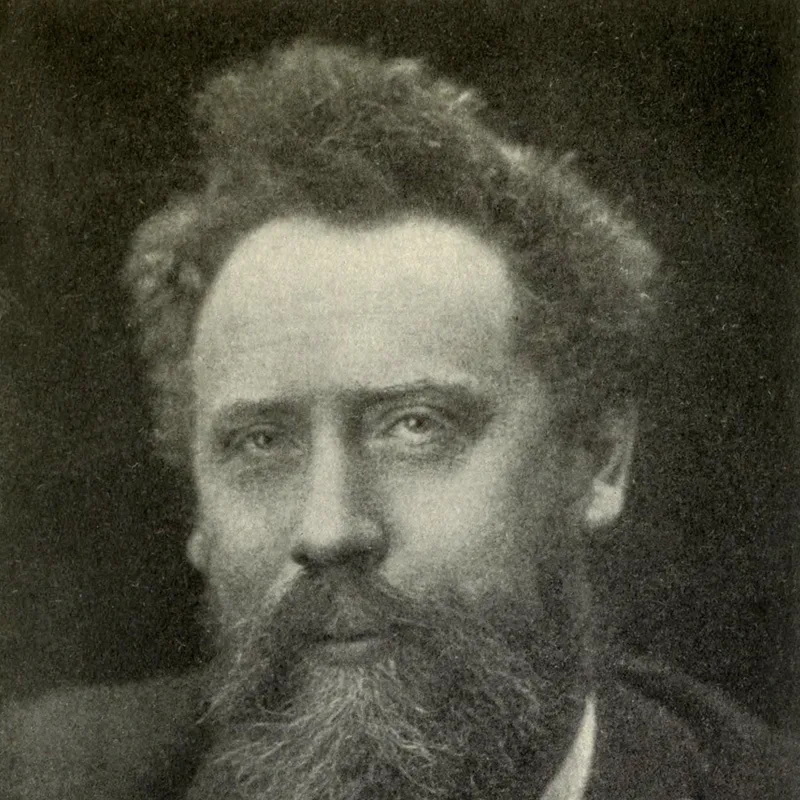
William Ernest Henley
Poet, Editor, Critic, 1849–1903
Stoic agnostic
What is the meaning of life?
Be the master of your fate, the captain of your soul.
Henley had tuberculosis of the bone from boyhood; one leg was amputated below the knee, and in 1873 he spent almost two years in the Edinburgh Royal Infirmary while Joseph Lister saved the other. There he wrote the hospital poems that made his name, among them the untitled lines now known as “Invictus”. Whatever comes, the poem says, a person can meet it unbowed: no circumstance, punishment or fear decides who you are. His friend Robert Louis Stevenson, who visited him in hospital, later told him that his maimed strength and masterfulness had given birth to Long John Silver.
-
“In the fell clutch of circumstance / I have not winced nor cried aloud. / Under the bludgeonings of chance / My head is bloody, but unbowed. … It matters not how strait the gate, / How charged with punishments the scroll, / I am the master of my fate: / I am the captain of my soul.”1
What is the meaning of the universe?
Whatever gods may be, the soul is unconquerable; beyond, only shade.
Henley did not claim to know whether there were gods: in “Invictus” he thanks “whatever gods may be” for his soul, and beyond this life he sees only the darkness of the shade. The poem promises no heaven and asks for no help; its whole force lies in facing the dark without them. Elsewhere he wrote of death not as a terror but as rest after work: “Margaritæ Sorori” (1876) ends with the wish to be gathered, when the long day is done, to the quiet west.
-
“Out of the night that covers me, / Black as the pit from pole to pole, / I thank whatever gods may be / For my unconquerable soul. … Beyond this place of wrath and tears / Looms but the Horror of the shade, / And yet the menace of the years / Finds, and shall find me, unafraid.”1
-
“So be my passing! / My task accomplish'd and the long day done, / My wages taken, and in my heart / Some late lark singing, / Let me be gather'd to the quiet west, / The sundown splendid and serene, / Death.”2