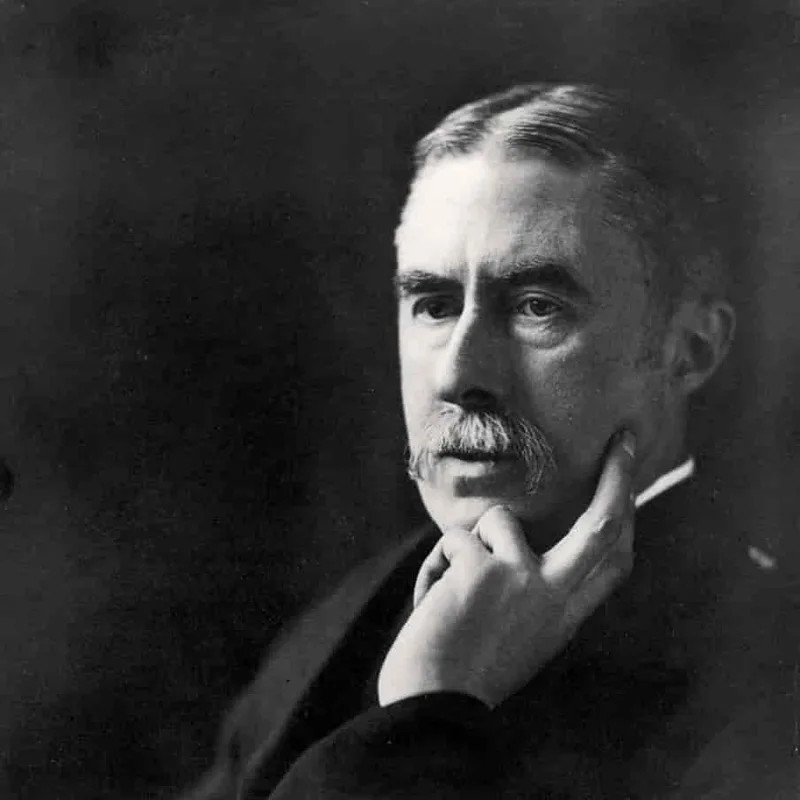
A. E. Housman
Poet, Classical scholar, 1859–1936
Atheist, raised Anglican
What is the meaning of life?
Life is short; go and look at things in bloom.
Housman was a Latin scholar, professor at University College London and then at Cambridge, famous for savage reviews of other scholars' editions of Manilius and Lucan. He published only two slim books of poems in his lifetime: A Shropshire Lad (1896), which he paid to have printed and which became one of the best-loved books of English verse, and Last Poems (1922). They are full of young men who die early, of lost love and of the brevity of things, and their answer to that brevity is to look: at twenty, with only fifty springs left, the speaker of the second poem resolves to go into the woods to see the cherry hung with snow.
-
“Now, of my threescore years and ten, / Twenty will not come again, / And take from seventy springs a score, / It only leaves me fifty more. / And since to look at things in bloom / Fifty springs are little room, / About the woodlands I will go / To see the cherry hung with snow.”1
What is the meaning of the universe?
A stranger and afraid in a world I never made.
Housman was brought up in the Church of England and, by his own later account, became a deist at thirteen and an atheist at twenty-one. His poems do not argue against God so much as live without him: nature goes on regardless of us, the dead lie quiet and do not return, and a man can only face with courage what he did not choose. Malt, one poem jokes, does more than Milton can to justify God's ways to man; in another the speaker stands, a stranger and afraid, in a world he never made.