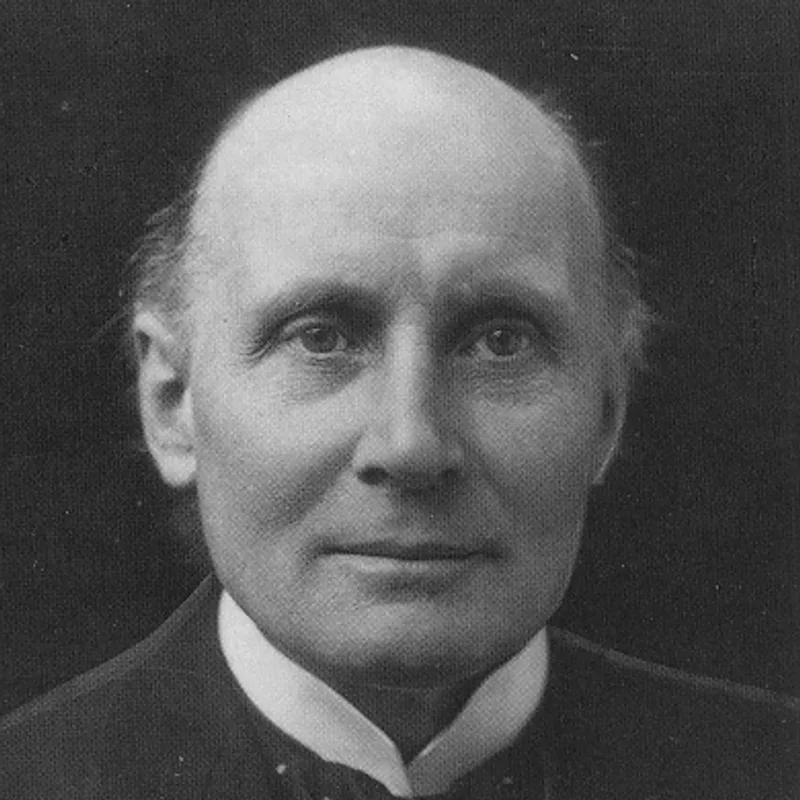
Alfred North Whitehead
Mathematician, Philosopher, 1861–1947
Process theist
What is the meaning of life?
Life finds its value only by merging with the universe.
Whitehead wrote Principia Mathematica (1910–13) with his former student Bertrand Russell, then moved to Harvard at sixty-three and turned metaphysician, building a “philosophy of organism” in which reality is made not of things but of events, processes of becoming. In Religion in the Making (1926) he called religion what the individual does with his own solitariness: alone, the spirit asks what, in the way of value, life attains, and finds no answer until its private claim is merged with that of the universe. Without the religious vision, he wrote, human life would be a flash of occasional enjoyments lighting up a mass of pain and misery.
-
“In its solitariness the spirit asks, What, in the way of value, is the attainment of life? And it can find no such value till it has merged its individual claim with that of the objective universe. Religion is world-loyalty.”1
-
“The fact of the religious vision, and its history of persistent expansion, is our one ground for optimism. Apart from it, human life is a flash of occasional enjoyments lighting up a mass of pain and misery, a bagatelle of transient experience.”2
What is the meaning of the universe?
Something beyond, behind and within the flux gives meaning to all.
Whitehead's God is not the unmoved ruler of classical theology. In his system God is the source of the possibilities the world can realise and is himself affected by everything that happens, growing with the world rather than standing outside it; the idea became the basis of what is now called process theology. Religion, he wrote in Science and the Modern World, is the vision of something which stands beyond, behind and within the passing flux of immediate things, something that gives meaning to all that passes and yet eludes apprehension. The worship of God, he added, is not a rule of safety but an adventure of the spirit.
-
“Religion is the vision of something which stands beyond, behind and within the passing flux of immediate things; something which is real, and yet waiting to be realized; something which is a remote possibility, and yet the greatest of present facts; something that gives meaning to all that passes, and yet eludes apprehension; something whose possession is the final good, and yet is beyond all reach; something which is the ultimate ideal, and the hopeless quest.”2
-
“The worship of God is not a rule of safety — it is an adventure of the spirit, a flight after the unattainable. The death of religion comes with the repression of the high hope of adventure.”2