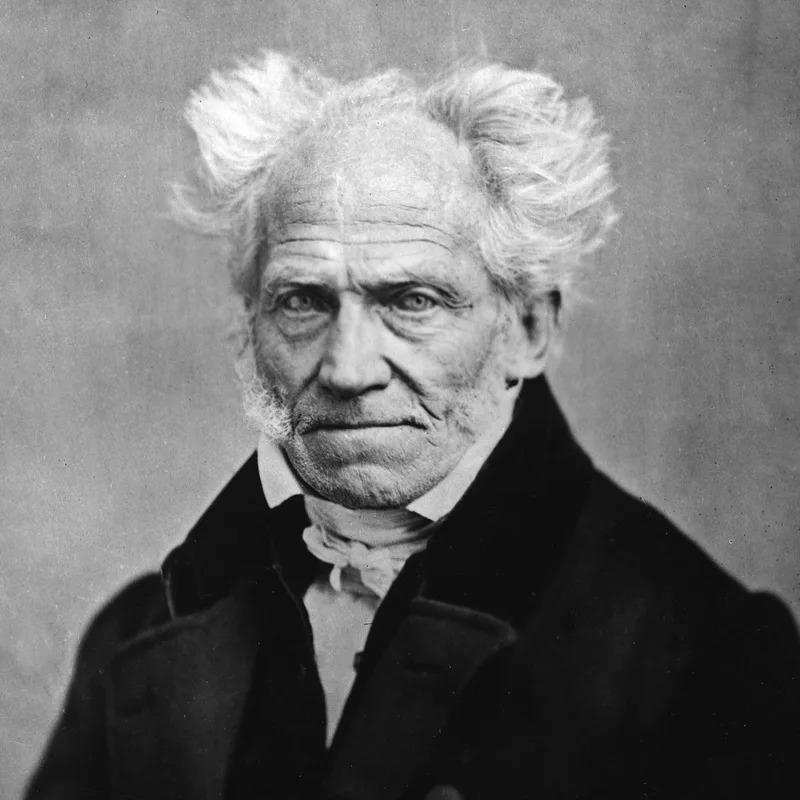
Arthur Schopenhauer
Philosopher, 1788–1860
Metaphysical pessimist
What is the meaning of life?
Suffering, mostly; the way out is compassion and renouncing the will.
Schopenhauer held that life was never arranged to make us happy. Under every appearance he found a blind will to live; willing means wanting, wanting means lack and pain, and satisfaction is brief before boredom follows. He called the belief that we exist in order to be happy the one inborn error, and life a business that does not cover its costs. His way out had three doors: art, which quiets the will for a moment; compassion, in which one being recognises itself in another; and the saint's denial of the will, which he found in the Upanishads, in Buddhism and in Christian ascetics. To one who has gone through that last door, he wrote, the whole world of suns and galaxies is nothing — and he meant it as consolation.
-
“There is only one inborn erroneous notion … that we exist in order to be happy … So long as we persist in this inborn error … the world seems to us full of contradictions. For at every step, in great things and small, we are bound to experience that the world and life are certainly not arranged for the purpose of maintaining a happy existence”1
-
“Life is a business that does not cover the costs.”2
-
“Boundless compassion for all living beings is the surest and most certain guarantee of pure moral conduct, and needs no casuistry. … The old Indian dramas close with these words: "May all living beings be delivered from pain." Tastes differ; but in my opinion there is no more beautiful prayer than this.”3
-
“Rather do we freely acknowledge that what remains after the entire abolition of will is for all those who are still full of will certainly nothing; but, conversely, to those in whom the will has turned and has denied itself, this our world, which is so real, with all its suns and milky-ways—is nothing.”4
What is the meaning of the universe?
One blind, striving Will behind all appearances; no God made it.
Schopenhauer took Kant's split between appearances and the thing in itself and named the thing in itself: Will. The world we know — suns, earth, our own bodies — is representation, an image in a knowing mind; behind it is one blind striving that appears as gravity in a stone, hunger in an animal and desire in us. He saw no creator in this picture: the misery of the world and the imperfection of its highest product ruled out an all-good, all-powerful God, and calling the world "God", as pantheists did, explained nothing. He admired the Upanishads and Buddhism for seeing the same thing earlier: plurality is appearance, Maya, and under it there is one being. Compassion, in his ethics, is what that unity feels like from inside.
-
“"The world is my idea:"—this is a truth which holds good for everything that lives and knows, though man alone can bring it into reflective and abstract consciousness. If he really does this, he has attained to philosophical wisdom. It then becomes clear and certain to him that what he knows is not a sun and an earth, but only an eye that sees a sun, a hand that feels an earth”5
-
“Spinoza (Epist. 62) says that if a stone which has been projected through the air had consciousness, it would believe that it was moving of its own will. I add to this only that the stone would be right. The impulse given it is for the stone what the motive is for me, and what in the case of the stone appears as cohesion, gravitation, rigidity, is in its inner nature the same as that which I recognise in myself as will”6
-
“There are two things which make it impossible to believe that this world is the successful work of an all-wise, all-good, and, at the same time, all-powerful Being; firstly, the misery which abounds in it everywhere; and secondly, the obvious imperfection of its highest product, man, who is a burlesque of what he should be.”7
-
“The chief objection I have to Pantheism is that it says nothing. To call the world "God" is not to explain it; it is only to enrich our language with a superfluous synonym for the word "world".”8