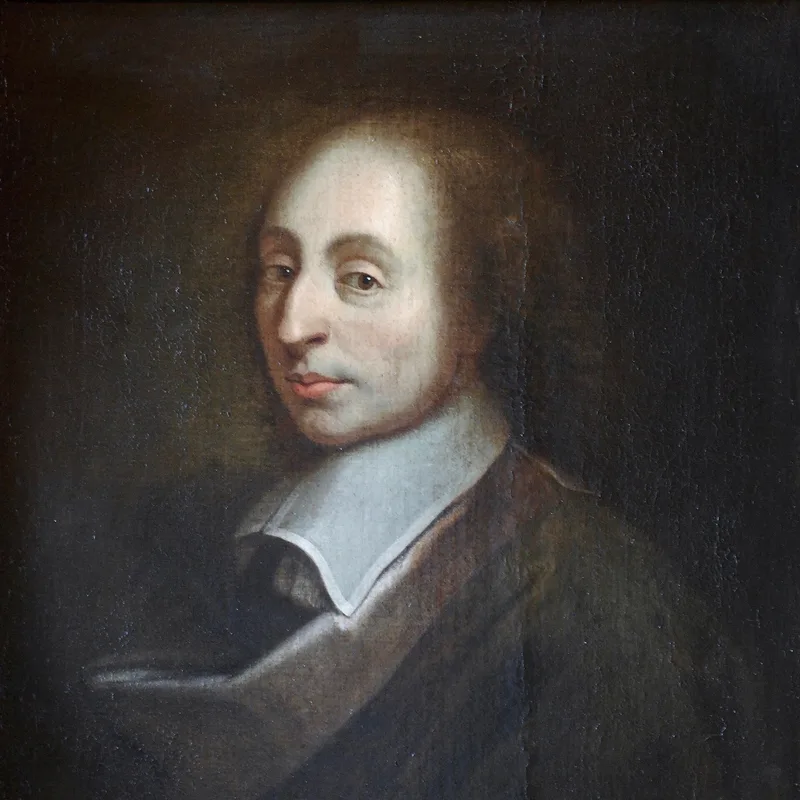
Blaise Pascal
Mathematician, Physicist, Religious philosopher, 1623–1662
Jansenist Catholic
What is the meaning of life?
All men seek happiness; only God can fill the infinite abyss.
Pascal was a mathematician and physicist who, after a night of religious experience in November 1654, turned to writing a defence of Christianity; the Pensées are the notes for that unfinished book, published in 1670, eight years after his death. His starting point is the human condition. Everyone seeks happiness without exception, yet no one finds it, and we fill our days with diversion so as not to think about death and our own wretchedness. That restlessness, he argued, is the trace of a happiness we have lost, and the infinite abyss in us can be filled only by God. Human greatness lies in thought — man is a thinking reed — so the task of a life is to think well, and to seek God with the heart.
-
“All men seek happiness. This is without exception. Whatever different means they employ, they all tend to this end. … But these are all inadequate, because the infinite abyss can only be filled by an infinite and immutable object, that is to say, only by God Himself.”1
-
“Man is but a reed, the most feeble thing in nature; but he is a thinking reed. … All our dignity consists, then, in thought. By it we must elevate ourselves, and not by space and time which we cannot fill. Let us endeavour, then, to think well; this is the principle of morality.”2
-
“Man is obviously made to think. It is his whole dignity and his whole merit; and his whole duty is to think as he ought. Now, the order of thought is to begin with self, and with its Author and its end.”3
What is the meaning of the universe?
Infinite silent spaces, and a hidden God known by the heart.
Pascal wrote from inside the new science: he had worked on the vacuum and on probability, and he faced the vastly enlarged cosmos of the new astronomy. In the Pensées man hangs between two infinities, the immensely large and the infinitely small, a nothing beside the infinite and an all beside nothing, and the eternal silence of those spaces frightened him. Nature, he thought, neither proves nor disproves God; it shows a hidden God. The wager argues that, faced with that uncertainty, it is reasonable to stake one's life on God's existence. The God he meant was not the God of the philosophers, the author of mathematical truths, but the God of Abraham, Isaac and Jacob, felt by the heart rather than reached by reason.
-
“The eternal silence of these infinite spaces frightens me.”4
-
“For in fact what is man in nature? A Nothing in comparison with the Infinite, an All in comparison with the Nothing, a mean between nothing and everything. Since he is infinitely removed from comprehending the extremes, the end of things and their beginning are hopelessly hidden from him in an impenetrable secret, he is equally incapable of seeing the Nothing from which he was made, and the Infinite in which he is swallowed up.”5
-
“Let us weigh the gain and the loss in wagering that God is. Let us estimate these two chances. If you gain, you gain all; if you lose, you lose nothing. Wager, then, without hesitation that He is.”6
-
“It is the heart which experiences God, and not the reason. This, then, is faith: God felt by the heart, not by the reason.”7