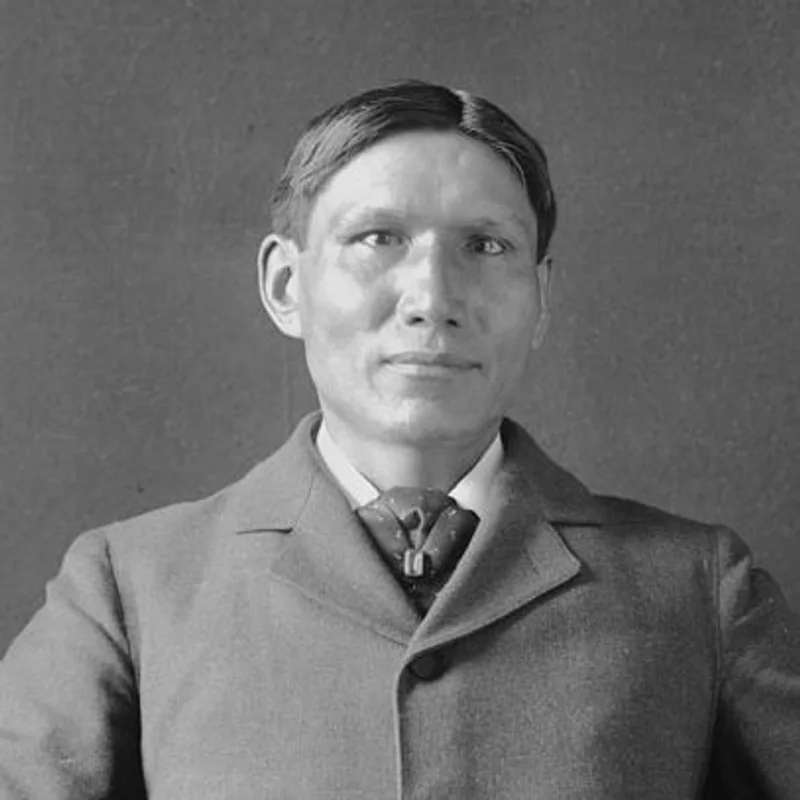
Charles Eastman (Ohiyesa)
Physician, Writer, 1858–1939
The Great Mystery
What is the meaning of life?
Silence, the poise of body, mind and spirit, is life's ideal.
Ohiyesa was born into a Santee Dakota family in Minnesota and raised in the traditional way after the Dakota War of 1862 drove his people into exile; at fifteen his father, who had converted to Christianity, brought him back into white society. He went on to study at Dartmouth and Boston University and became one of the first Native American physicians, treating the wounded after the massacre at Wounded Knee in 1890. In books such as The Soul of the Indian (1911) he set out the spiritual ideals of his people for white readers. Their ideal of life, he wrote, was silence: the absolute poise of body, mind and spirit, a self kept calm and unshaken by the storms of existence, whose fruits are self-control, courage, patience, dignity and reverence.
-
“He believes profoundly in silence—the sign of a perfect equilibrium. Silence is the absolute poise or balance of body, mind, and spirit. The man who preserves his selfhood ever calm and unshaken by the storms of existence—not a leaf, as it were, astir on the tree; not a ripple upon the surface of shining pool—his, in the mind of the unlettered sage, is the ideal attitude and conduct of life.”1
What is the meaning of the universe?
The Great Mystery surrounds and embraces us, worshipped in silence.
Eastman became a Christian and believed that the spirit of Christianity and the old Dakota religion were essentially the same, but he was a sharp critic of what he called the paradox of “Christian civilization”, which preached the Gospel while it took the land. The religion of his ancestors, as he described it, had no creed, no temples and no priests: the Eternal, the Great Mystery that surrounds and embraces us, was worshipped alone, in the wilderness, and in silence, because all speech is feeble and imperfect before it. Each soul, he wrote, must meet the morning sun, the new, sweet earth and the Great Silence alone.
-
“The original attitude of the American Indian toward the Eternal, the “Great Mystery” that surrounds and embraces us, was as simple as it was exalted. To him it was the supreme conception, bringing with it the fullest measure of joy and satisfaction possible in this life. The worship of the “Great Mystery” was silent, solitary, free from all self-seeking.”2