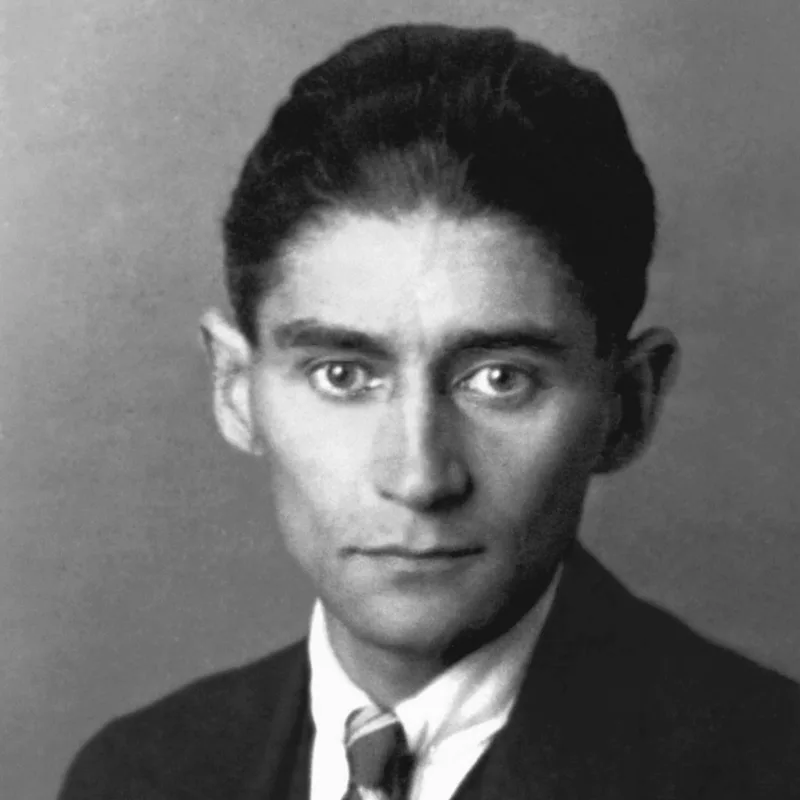
Franz Kafka
Novelist, Short-story writer, 1883–1924
Believer in the indestructible
What is the meaning of life?
To trust the indestructible in oneself, without striving toward it.
Kafka's most direct answers come from 1917–18, after tuberculosis was diagnosed, when he lived for some months with his sister Ottla in the Bohemian village of Zürau, a time he later called perhaps the best of his life. From his notebooks there he copied 109 numbered reflections onto separate slips of paper; they were published after his death and are now known as the Zürau aphorisms. They say that there is a goal but no way, and that what we call a way is hesitation; happiness is possible in theory, by believing in the indestructible element in oneself without striving toward it. His diary of October 1921 adds that the splendour of life lies ready around each of us, veiled and far off but not hostile, and comes when it is called by its right name.
-
“There is a goal, but no way; what we call a way is hesitation.”1
-
“Theoretically there is a perfect possibility of happiness: believing in the indestructible element in oneself and not striving towards it.”2
-
“It is entirely conceivable that life’s splendour forever lies in wait about each one of us in all its fullness, but veiled from view, deep down, invisible, far off. It is there, though, not hostile, not reluctant, not deaf. If you summon it by the right word, by its right name, it will come. This is the essence of magic, which does not create but summons.”3
What is the meaning of the universe?
Nothing but a spiritual world; ours, a bad mood of God.
Kafka grew up in Prague as a German-speaking Jew and called himself an atheist as a teenager, yet Judaism, the Talmud and the Kabbalah run through his diaries, and he was drawn to the intense spiritual life he saw among the Jews of Eastern Europe. The Zürau aphorisms are his most direct statements: there is nothing but a spiritual world, what we call the world of the senses is the evil in it, and the fact that nothing else exists takes away hope and gives certainty. A person cannot live without a lasting trust in something indestructible within, even if both the trust and its object stay hidden; faith in a personal God is one form that hiddenness takes. In a conversation that Max Brod recorded around 1920, Kafka called our world a bad mood of God, a bad day, and said there was plenty of hope, only not for us.
-
“Man cannot live without a permanent trust in something indestructible in himself, though both the indestructible element and the trust may remain permanently hidden from him. One of the ways in which this hiddenness can express itself is through faith in a personal god.”4
-
“The fact that there is nothing but a spiritual world deprives us of hope and gives us certainty.”5
-
“Plenty of hope — for God — no end of hope — only not for us.”6