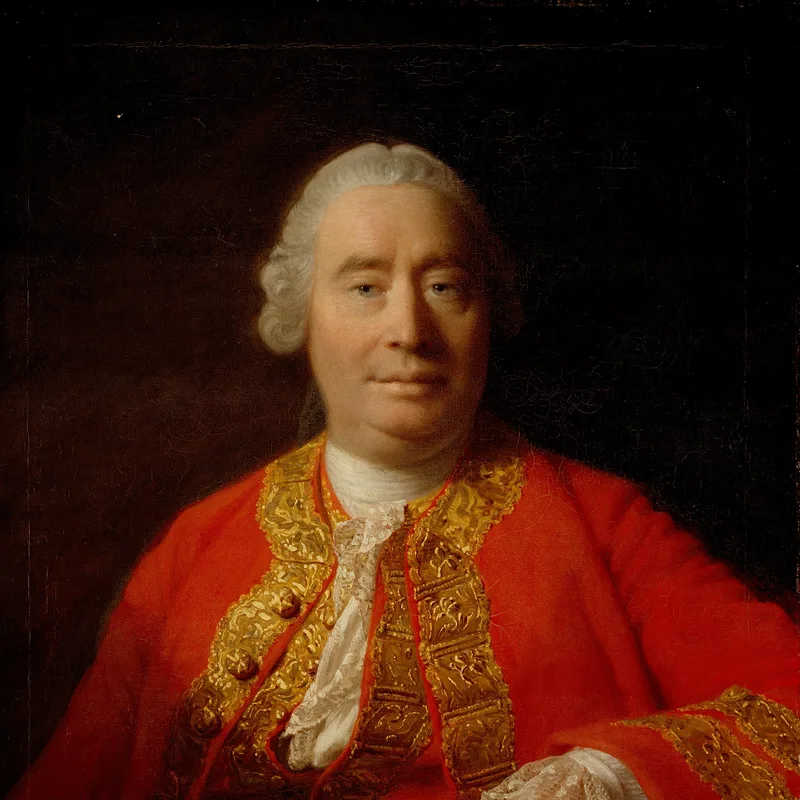
David Hume
Philosopher, Historian, Essayist, 1711–1776
Skeptic
What is the meaning of life?
Philosophize, but stay human: dine, play, talk with friends.
Hume finished A Treatise of Human Nature in his twenties and found that reason, followed to the end, leaves almost nothing certain: not causes, not the self, not the outside world. What rescued him from that melancholy was not an argument but nature: dinner, a game of backgammon, conversation with friends, after which his doubts looked cold and ridiculous. His advice in the later Enquiry is to keep philosophy inside human life rather than let it replace it. In a short autobiography written months before his death he described himself as a man of mild disposition and cheerful temper, and friends found him calm and good-humoured to the end.
-
“Be a philosopher; but, amidst all your philosophy, be still a man.”1
-
“I dine, I play a game of backgammon, I converse, and am merry with my friends; and when after three or four hours' amusement, I would return to these speculations, they appear so cold, and strained, and ridiculous, that I cannot find in my heart to enter into them any farther.”2
What is the meaning of the universe?
A riddle and an inexplicable mystery; suspend judgment.
Hume took apart the main arguments for religion: no testimony can prove a miracle, and the order of nature, which looks designed, could have other causes and tells us little about the goodness or power of any designer. His Dialogues Concerning Natural Religion, published after his death as he had arranged, leave the question to characters who disagree. He never called himself an atheist, and his own conclusion in The Natural History of Religion was doubt. Against human self-importance he set the scale of the universe, to which a human life matters no more than an oyster's.