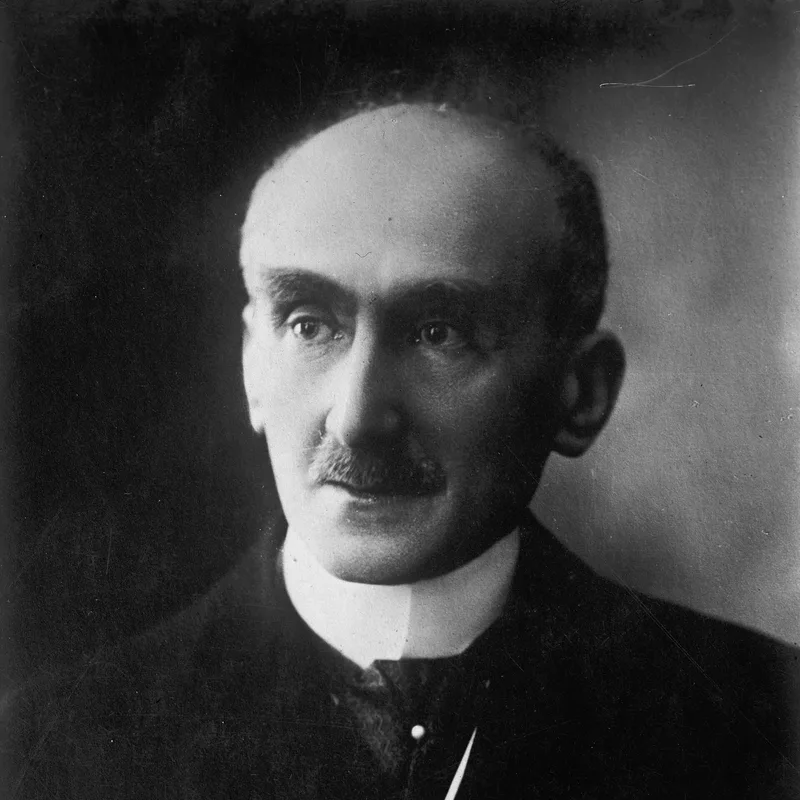
Henri Bergson
Philosopher, 1859–1941
Vitalist, drawn to Catholicism
What is the meaning of life?
To exist is to change, to mature, and to keep creating oneself.
Bergson was the most celebrated philosopher in France in the early twentieth century; his lectures in Paris drew crowds, and he won the Nobel Prize in Literature in 1927. Against the mechanical picture of life, he argued that real time, as we live it, is duration: a flowing, indivisible growth in which the past is carried into the present. A conscious being is never finished. For such a being, he wrote, to exist is to change, to change is to mature, and to mature is to go on creating oneself endlessly.
-
“We are seeking only the precise meaning that our consciousness gives to this word “exist,” and we find that, for a conscious being, to exist is to change, to change is to mature, to mature is to go on creating oneself endlessly.”1
What is the meaning of the universe?
The universe endures and creates; it is a machine for making gods.
For Bergson the universe is not a machine whose future is contained in its past but a process that endures and keeps inventing new forms. Life is driven by a vital impetus, the élan vital, which pushes evolution toward ever greater freedom and consciousness. In his last major book, The Two Sources of Morality and Religion (1932), he concluded that this creative energy is love, and that the mystics who feel it show what humanity is for; he ended it by calling the universe a machine for the making of gods. Raised Jewish, he wrote in his will that his reflections had brought him close to Catholicism, but that he would not convert while Jews were being persecuted.
-
“…we live the duration immanent to the whole of the universe. The universe endures. The more we study the nature of time, the more we shall comprehend that duration means invention, the creation of forms, the continual elaboration of the absolutely new.”1
-
“…the universe, which is a machine for the making of gods.”2