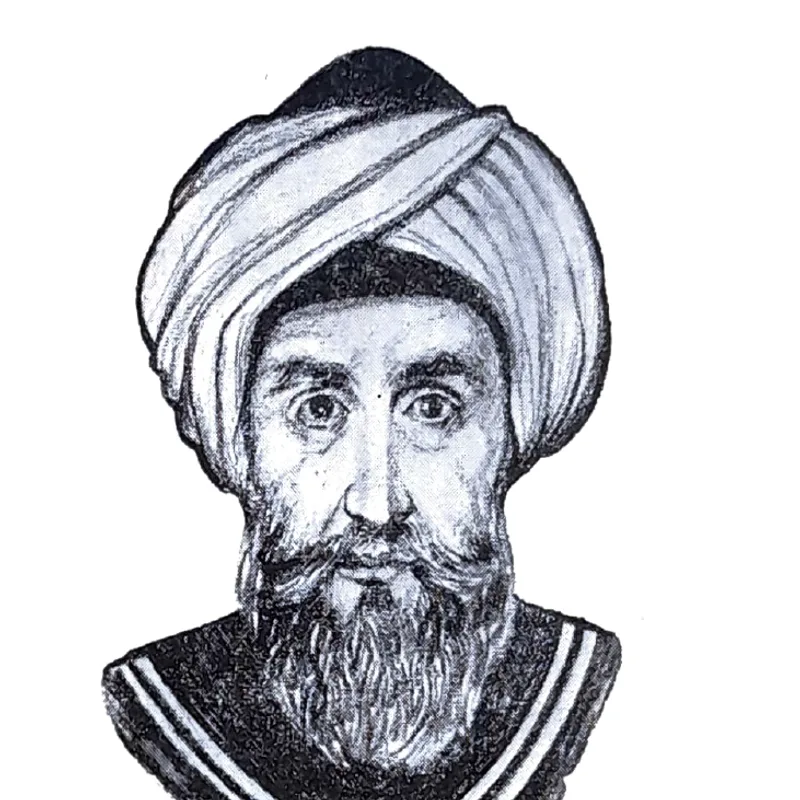
Ibn Arabi
Sufi mystic, Philosopher, Poet, 1165–1240
Unity of Being
What is the meaning of life?
I follow the religion of Love, whichever way its camels take.
Ibn Arabi was born in Murcia in Muslim Spain, travelled across North Africa and settled at last in Damascus, after years in Mecca and Anatolia, where his stepson and disciple Sadreddin Konevi carried his teaching into the Seljuk world. His hundreds of works, above all The Meccan Revelations and The Bezels of Wisdom, made him the most influential philosopher of Sufism, honoured as “the Greatest Master”. In a collection of love poems, The Interpreter of Desires, he declared a heart open to every form of worship: a pasture for gazelles and a convent for monks, a temple for idols and the Kaaba, the Torah and the Qur'an. He follows the religion of love, wherever its camels take him.
-
“My heart has become capable of every form: it is a pasture for gazelles and a convent for Christian monks, / And a temple for idols, and the pilgrim’s Kaʿba, and the tables of the Tora and the book of the Koran. / I follow the religion of Love, whichever way his camels take. My religion and my faith is the true religion.”1
What is the meaning of the universe?
No single creed holds God; none sees Him but Himself.
Ibn Arabi's teaching is known as the Unity of Being: there is only one reality, God, and the world is His self-manifestation, the eternal and the created being two complementary aspects of the One. Every creed therefore sees God in the form it is able to receive, and no creed holds Him whole; those who worship Him in the sun see the sun. The mystic who knows this does not bind himself to any one belief, for God is not confined to one. And in the end even the seeing is God's: we see Him with His eye, not ours.
-
“Those who adore God in the sun … behold the sun, and those who adore Him in living things see a living thing, and those who adore Him in lifeless things see a lifeless thing, and those who adore Him as a Being unique and unparalleled see that which has no like. Do not attach yourself … to any particular creed exclusively, so that you disbelieve in all the rest…”2
-
“With what eye do I see Him? / With His eye, not with mine, / For none sees Him except Himself.”3