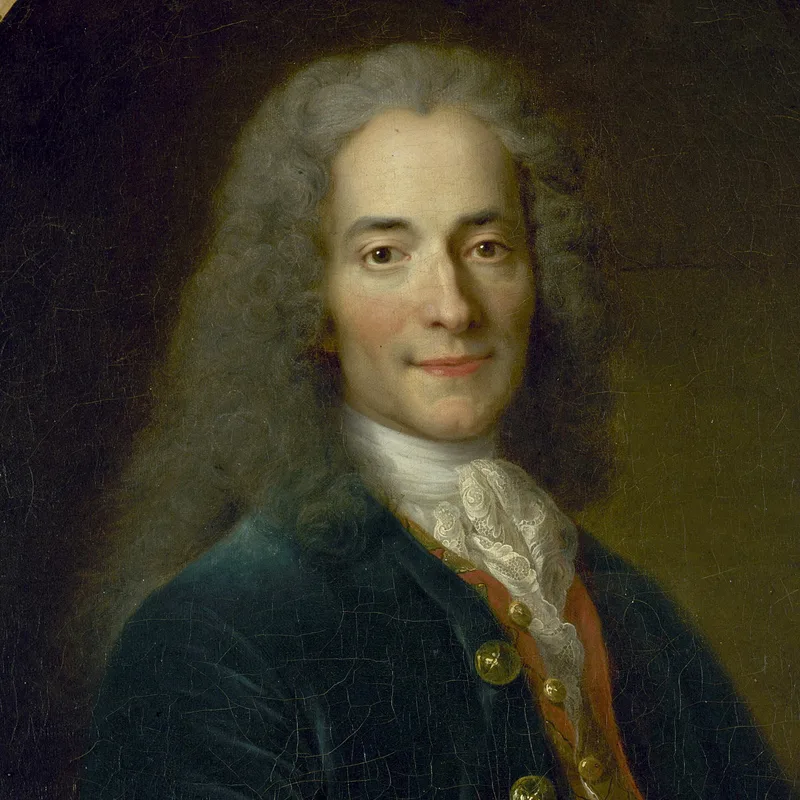
Voltaire
Writer, Philosopher, 1694–1778
Deist
What is the meaning of life?
Work without theorizing: we must cultivate our garden.
Voltaire distrusted grand answers to the question. Candide (1759) takes its hero through war, shipwreck, the Lisbon earthquake and the Inquisition while his tutor Pangloss insists that all is for the best; it ends on a small farm near Constantinople, where an old Turk has told them that work keeps away boredom, vice and need, and with Candide's reply to one more speech from Pangloss: let us cultivate our garden. Voltaire used the image in his own letters too, as the only remedy he knew for a life full of thorns. Happiness, he noted, is something everyone looks for without knowing where to find it. The rule he pressed hardest was tolerance: we are all made of weakness and error, so we should forgive one another.
-
“"All that is very well," answered Candide, "but let us cultivate our garden."”1
-
“Life is bristling with thorns, and I know no other remedy than to cultivate one's garden.”2
-
“We all look for happiness, but without knowing where to find it: like drunkards who look for their house, knowing dimly that they have one.”3
-
“What is tolerance? It is the consequence of humanity. We are all formed of frailty and error; let us pardon reciprocally each other's folly — that is the first law of nature.”4
What is the meaning of the universe?
A supreme intelligence orders nature; why evil exists, no one knows.
Voltaire was a deist: that a supreme, intelligent being exists was for him a matter of reason, not faith, and he fought what he called l'infâme, the superstition and intolerance fostered by the clergy. His best-known line on God, that if God did not exist it would be necessary to invent him, comes from a verse epistle of 1770 to the author of the Treatise of the Three Impostors, a book denying all three Abrahamic religions; in a letter the same month he added that all nature cries out that God exists. What the theist cannot know, he wrote in the Philosophical Dictionary, is how God acts. The Lisbon earthquake of 1755, which killed between 30,000 and 50,000 people, turned him against the optimism of Leibniz and Pope: evil is real, its source is unknown, and "all is well" is only a hope for one day. In February 1778, three months before he died, he wrote that he was dying adoring God, loving his friends, not hating his enemies and detesting superstition.
-
“If God did not exist, it would be necessary to invent him.”5
-
“But all nature cries aloud that he does exist: that there is a supreme intelligence, an immense power, an admirable order, and everything teaches us our own dependence on it.”6
-
“The theist does not know how God punishes, how he protects, how he pardons, for he is not reckless enough to flatter himself that he knows how God acts, but he knows that God acts and that He is just. Difficulties against Providence do not shake him in his faith, because they are merely great difficulties, and not proofs.”7
-
“All will be well one day—so runs our hope. / All now is well, is but an idle dream. / The wise deceive me: God alone is right.”8