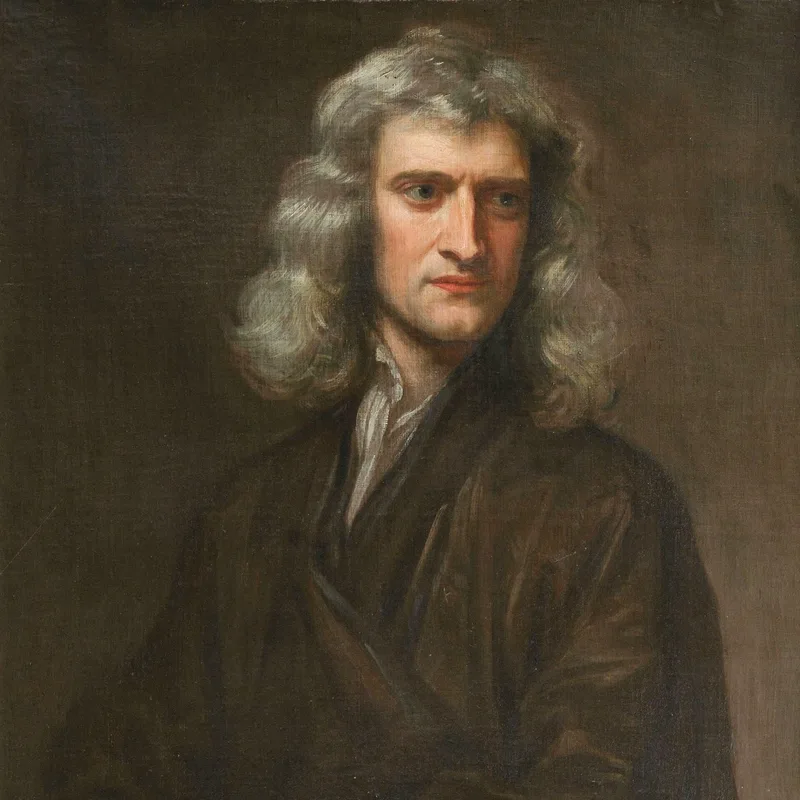
Isaac Newton
Physicist, Mathematician, 1643–1727
Heterodox Christian
What is the meaning of life?
To know God through his works, and love your neighbour.
Newton wrote no book on the meaning of life, but his private theological manuscripts say what he thought a life was for. In a late paper, A short Schem of the true Religion, he reduced religion to two duties: godliness, the knowledge, love and worship of God, and humanity, love and good offices towards other people. He put his science inside that frame. In the Opticks he argued that the better natural philosophy knows the first Cause, the clearer our duty to God and to one another becomes, and he told Richard Bentley he had written the Principia with an eye to principles that might lead thinking men to believe in a Deity. About his own life's work he was, by Brewster's account, modest: a boy picking up pebbles while the ocean of truth lay undiscovered.
-
“Godliness consists in the knowledge love & worship of God, Humanity in love, righteousness & good offices towards man.”1
-
“The other part of the true religion is our duty to man. We must love our neighbour as our selves, we must be charitable to all men for charity is the greatest of graces, greater then even faith or hope & covers a multitude of sins. We must be righteous & do to all men as we would they should do to us.”1
-
“And if natural Philosophy in all its Parts, by pursuing this Method, shall at length be perfected, the Bounds of Moral Philosophy will be also enlarged. For so far as we can know by natural Philosophy what is the first Cause, what Power he has over us, and what Benefits we receive from him, so far our Duty towards him, as well as that towards one another, will appear to us by the Light of Nature.”2
-
“I do not know what I may appear to the world, but to myself I seem to have been only like a boy playing on the sea-shore, and diverting myself in now and then finding a smoother pebble or a prettier shell than ordinary, whilst the great ocean of truth lay all undiscovered before me.”3
What is the meaning of the universe?
A system of laws, ruled by an intelligent and powerful Being.
Newton held that the order of the solar system could not have come from mechanical causes alone. In the General Scholium he added to the second edition of the Principia (1713), he argued that the system of sun, planets and comets could only proceed from the counsel and dominion of an intelligent and powerful Being: a God who is Lord over all rather than the soul of the world, known to us only through his works. Gravity itself, he told Bentley in 1693, needed an agent acting constantly by laws, and in the Opticks he described a Being who perceives everything in infinite space as if in his sensorium. In private he rejected the doctrine of the Trinity and called atheism senseless, because the uniform design of living bodies betrayed an Author. For Newton, to discourse of God from the appearances of things was part of natural philosophy, not something outside it.
-
“This most beautiful system of the sun, planets, and comets, could only proceed from the counsel and dominion of an intelligent and powerful Being. And if the fixed stars are the centres of other like systems, these, being formed by the like wise counsel, must be all subject to the dominion of One…”4
-
“We know him only by his most wise and excellent contrivances of things, and final causes: we admire him for his perfections; but we reverence and adore him on account of his dominion: for we adore him as his servants; and a god without dominion, providence, and final causes, is nothing else but Fate and Nature.”4
-
“It is inconceivable that inanimate brute matter should, without the mediation of something else which is not material, operate upon and affect other matter without mutual contact, as it must be, if gravitation in the sense of Epicurus, be essential and inherent in it. … Gravity must be caused by an agent acting constantly according to certain laws; but whether this agent be material or immaterial, I have left open to the consideration of my readers.”5
-
“[D]oes it not appear from Phænomena that there is a Being incorporeal, living, intelligent, omnipresent, who in infinite Space, as it were in his Sensory, sees the things themselves intimately, and throughly perceives them, and comprehends them wholly by their immediate presence to himself.”6