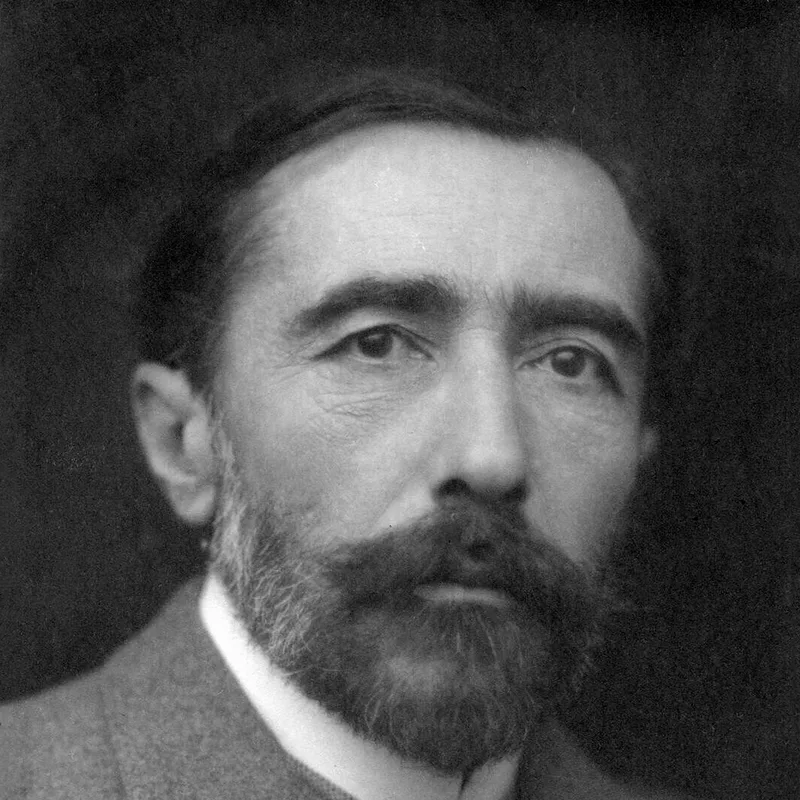
Joseph Conrad
Novelist, Master mariner, 1857–1924
Skeptic, nominal Catholic
What is the meaning of life?
Fidelity, and attention to the living universe.
Conrad was born Józef Korzeniowski to Polish parents in Russian-ruled Ukraine, was orphaned at eleven, went to sea at sixteen and spent twenty years as a sailor before settling in England and writing, in his third language, Heart of Darkness, Lord Jim and Nostromo. His novels are full of people tested by isolation, temptation and the sea, and what holds or fails them is rarely a doctrine. In his memoir A Personal Record (1912) he wrote that the world rests on a few very simple ideas, above all the idea of fidelity. Our task on earth, he suggested, may be to attend, unwearied and self-forgetful, to every part of the living universe and to bear true testimony to it.
-
“Those who read me know my conviction that the world, the temporal world, rests on a few very simple ideas; so simple that they must be as old as the hills. It rests notably, among others, on the idea of Fidelity.”1
-
“And the unwearied self-forgetful attention to every phase of the living universe reflected in our consciousness may be our appointed task on this earth—a task in which fate has perhaps engaged nothing of us except our conscience, gifted with a voice in order to bear true testimony to the visible wonder, the haunting terror, the infinite passion, and the illimitable serenity…”2
What is the meaning of the universe?
Creation's aim is not ethical but a spectacle, never for despair.
Conrad was baptised a Catholic but did not practise, and his biographer Jeffrey Meyers describes him as an atheist. He did not think the universe was run on moral lines: an ethical view of it, he wrote in A Personal Record, ends in cruel and absurd contradictions. He preferred to believe that the aim of creation is purely spectacular, a sight to move us to awe, love, adoration or even hate, but never to despair; what we make of it is our own affair. In that view, he added, there is room for every religion except the creed of despair.
-
“The ethical view of the universe involves us at last in so many cruel and absurd contradictions… that I have come to suspect that the aim of creation cannot be ethical at all. I would fondly believe that its object is purely spectacular: a spectacle for awe, love, adoration, or hate, if you like, but in this view—and in this view alone—never for despair!”2
-
“In this view there is room for every religion except for the inverted creed of impiety, the mask and cloak of arid despair; for every joy and every sorrow, for every fair dream, for every charitable hope.”2