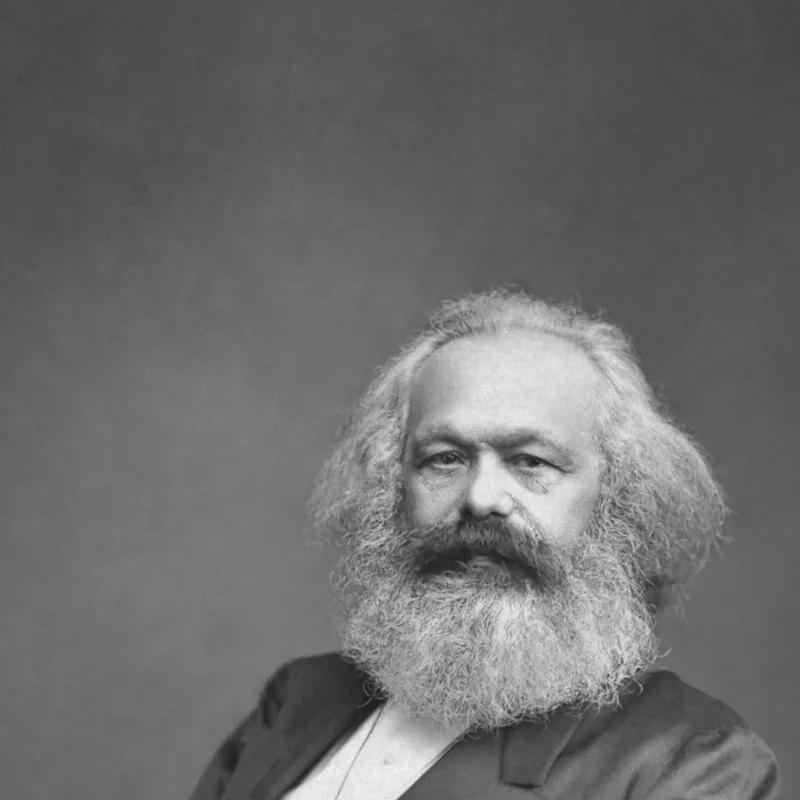
Karl Marx
Philosopher, Economist, Revolutionary, 1818–1883
Atheist materialist
What is the meaning of life?
Free, creative work for humanity; the point is to change the world.
In an essay of 1835, written in his last year at the Gymnasium in Trier, Marx argued that the right vocation is the one in which a person can work most for humanity, and that happiness found that way belongs to millions. The idea stayed with him in a harder form. In the manuscripts he wrote in Paris in 1844 he described free, conscious, productive activity as what makes us human, and argued that wage labour turns it into a mere means of staying alive. Since, as he put it, man is the highest being for man, the conditions that degrade people have to be overthrown. In 1845 he put the whole stance into the eleventh of his theses on Feuerbach: philosophers have only interpreted the world; the point is to change it.
-
“When we have chosen the vocation in which we can contribute most to humanity, burdens cannot bend us because they are only sacrifices for all. Then we experience no meager, limited, egotistic joy, but our happiness belongs to millions, our deeds live on quietly but eternally effective, and glowing tears of noble men will fall on our ashes.”1
-
“For labor, life activity, productive life itself, appears to man in the first place merely as a means of satisfying a need – the need to maintain physical existence. Yet the productive life is the life of the species. It is life-engendering life. The whole character of a species, its species-character, is contained in the character of its life activity; and free, conscious activity is man's species-character.”2
-
“The philosophers have only interpreted the world, in various ways; the point is to change it.”3
What is the meaning of the universe?
Man makes religion; nature exists on its own account.
Marx was baptised a Lutheran as a child and was an atheist by his student years in Berlin. In the introduction to his critique of Hegel's philosophy of right, written in 1843–44, he argued that man makes religion, not the reverse: an upside-down society produces religion as an upside-down picture of the world. The famous line about the opium of the people is usually quoted alone, but in full the passage treats religion as both an expression of real suffering and a protest against it, an illusory happiness whose abolition is the demand for real happiness. In the 1844 manuscripts he dismissed the question of who created the first man and nature as itself the product of an abstraction. For him nature and man exist on their own account, and the science of the earth's formation had already dealt the idea of creation a heavy blow.
-
“The foundation of irreligious criticism is: Man makes religion, religion does not make man. Religion is, indeed, the self-consciousness and self-esteem of man who has either not yet won through to himself, or has already lost himself again.”4
-
“Religious suffering is, at one and the same time, the expression of real suffering and a protest against real suffering. Religion is the sigh of the oppressed creature, the heart of a heartless world, and the soul of soulless conditions. It is the opium of the people. The abolition of religion as the illusory happiness of the people is the demand for their real happiness.”4
-
“When you ask about the creation of nature and man, you are abstracting, in so doing, from man and nature. You postulate them as non-existent, and yet you want me to prove them to you as existing. Now I say to you: Give up your abstraction and you will also give up your question.”5