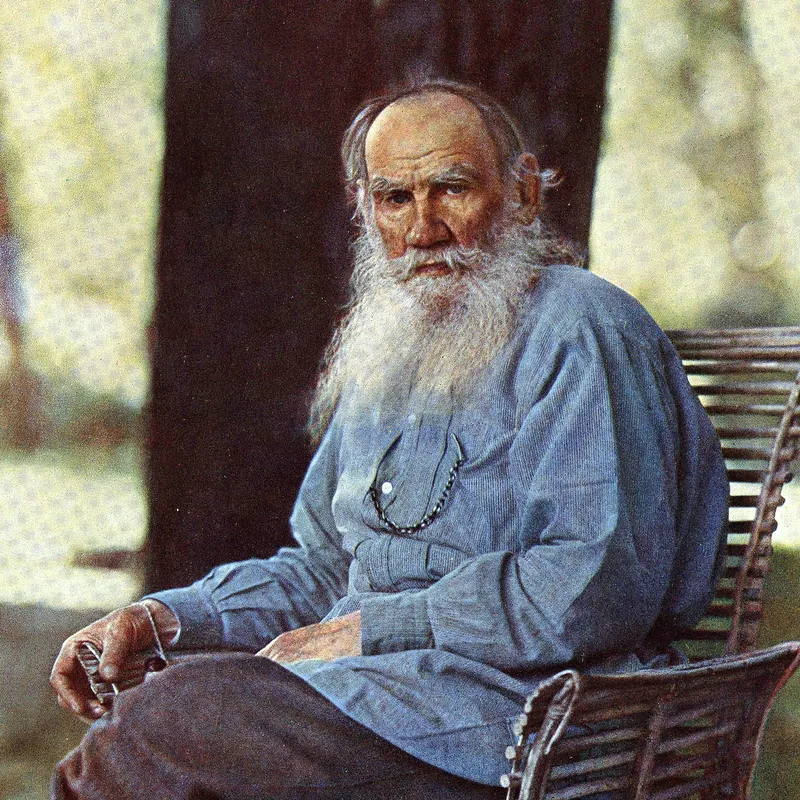
Leo Tolstoy
Novelist, Essayist, 1828–1910
Christian anarchist
What is the meaning of life?
To know God and to live are the same; increase love.
At about fifty, after War and Peace and Anna Karenina, Tolstoy fell into a crisis he describes in A Confession (1882): he had wealth, fame and a family, and could find no meaning in his life that death would not destroy. Science answered other questions; reason, he wrote, gave him only that zero equals zero. He hid the rope and stopped carrying a gun. What brought him back was faith as he saw it lived by ordinary working people, and an inner realisation that he was alive only when he sought God. In later life he put the answer plainly: the meaning of every life lies in increasing the love in it, and in helping to bring about the Kingdom of God on earth.
-
“Differently expressed, the question is: 'Why should I live, why wish for anything, or do anything?' It can also be expressed thus: 'Is there any meaning in my life that the inevitable death awaiting me does not destroy?'”1
-
“'What more do you seek?' exclaimed a voice within me. 'This is He. He is that without which one cannot live. To know God and to live is one and the same thing. God is life.' 'Live seeking God, and then you will not live without God.'”2
-
“I believe, therefore, that the meaning of the life of every man is to be found only in increasing the love that is in him; that this increase of love leads man, even in this life, to ever greater and greater blessedness, and after death gives him the more blessedness the more love he has, and helps more than anything else towards the establishment of the Kingdom of God on earth.”3
What is the meaning of the universe?
God is the infinite All; each of us a finite part.
Tolstoy's God was not the Orthodox Church's. He rejected the Trinity, the miracles, the divinity of Jesus and a personal life beyond the grave, and kept what he read as Christ's teaching: love, non-resistance to evil, the Kingdom of God within. The Holy Synod excommunicated him in 1901; in his reply he set out his creed — God as Spirit, as Love, as the Source of all, in him as he was in God. In his diary a week before his death he gave it a last form: God is the infinite All of which a person is a finite part, and love is what joins one manifestation of God to the others.
-
“I believe in this: I believe in God, whom I understand as Spirit, as Love, as the Source of all. I believe that he is in me and I in him. I believe that the will of God is most clearly and intelligibly expressed in the teaching of the man Jesus, whom to consider as God, and pray to, I esteem the greatest blasphemy.”3
-
“God is that infinite All of which man knows himself to be a finite part. God alone exists truly. Man manifests Him in time, space and matter. The more God's manifestation in man (life) unites with the manifestations (lives) of other beings, the more man exists. This union with the lives of other beings is accomplished through love.”4
-
“Never did Christ utter a single word attesting to a personal resurrection and a life beyond the grave.”5