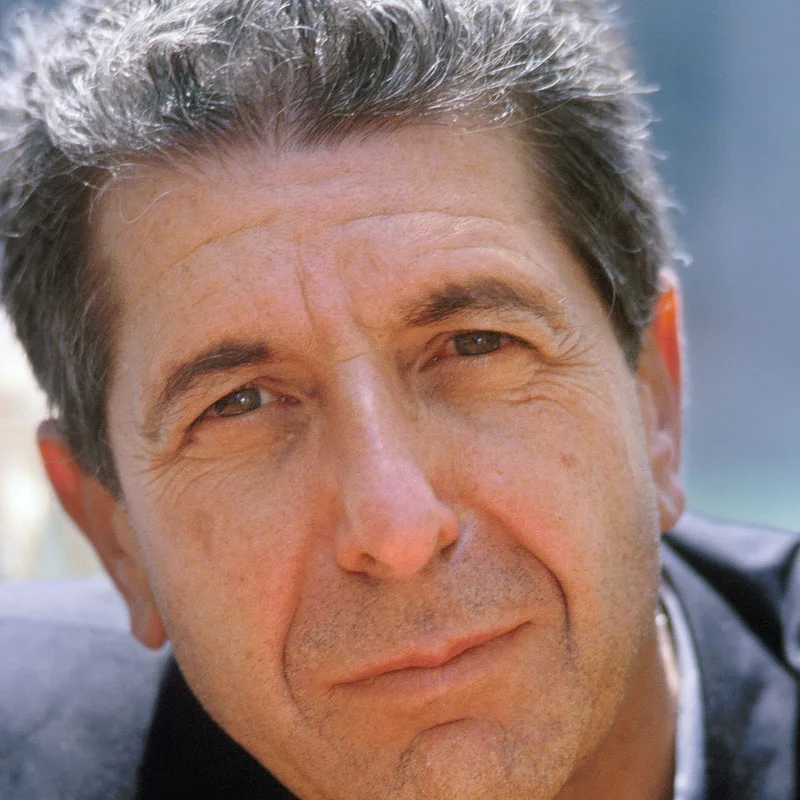
Leonard Cohen
Singer-songwriter, Poet, Novelist, 1934–2016
Observant Jew, Zen monk
What is the meaning of life?
Be strong and cheerful without hope, and let yourself be loved.
Cohen was called the poet of gloom for most of his career and rejected the label. In 1993 he said he had always been free from hope and felt invited to make himself strong and cheerful — the gravity of the human predicament, not his temperament, explained the darkness. In the same year he described the life worth living in biblical terms: at our best we stand in a biblical landscape, and life is only worth redeeming if we accept its invitation. After five years at the Mount Baldy Zen Center, where he said his long depression lifted, he talked about love less as an effort than as something to stop resisting.
-
“I've always been free from hope. It's never been one of my great solaces. I feel that more and more we're invited to make ourselves strong and cheerful.”1
-
“At our best, we inhabit a biblical landscape, and this is where we should situate ourselves without apology. … That biblical landscape is our urgent invitation … Otherwise, it's really not worth saving or manifesting or redeeming or anything, unless we really take up that invitation to walk into that biblical landscape.”2
-
“You could say that God is speaking to you or the cosmos, or your lover. It just means, like, Forget it. Lean back and be loved by all that is already loving you. It is your effort at love that is preventing you from experiencing it.”3
What is the meaning of the universe?
An eye that watches us all; a judgment that weighs everything.
Cohen was born into a prominent Montreal Jewish family that traced itself to the priestly line of Aaron, and he kept the Sabbath even on tour. From the 1970s he studied Zen with the teacher Joshu Sasaki, and in 1996 was ordained a Rinzai monk with the name Jikan, silence. He saw no conflict: the Zen he practised had no prayer and affirmed no deity, so it posed no challenge to Jewish belief. When he spoke of God from the stage it was often as a judge — introducing Hallelujah in Warsaw in 1985 he spoke of an eye that watches all of us and a judgment greater than any government. He said his study of other traditions had enriched his own, and he was buried with a Jewish rite in 2016.
-
“I know there is an eye that watches all of us. There is a judgment that weighs everything we do. And before this great force, which is greater than any government I stand in awe and I kneel in respect and it is to this great judgment that I dedicate this next song, "Hallelujah".”4
-
“Well, for one thing, in the tradition of Zen that I've practiced, there is no prayerful worship and there is no affirmation of a deity. So theologically there is no challenge to any Jewish belief.”5
-
“That's why I've tried to correct that impression [that I was looking for another religion besides Judaism] because I very much feel part of that tradition and I practice that and my children practice it, so that was never in question. The investigations that I've done into other spiritual systems have certainly illuminated and enriched my understanding of my own tradition.”6