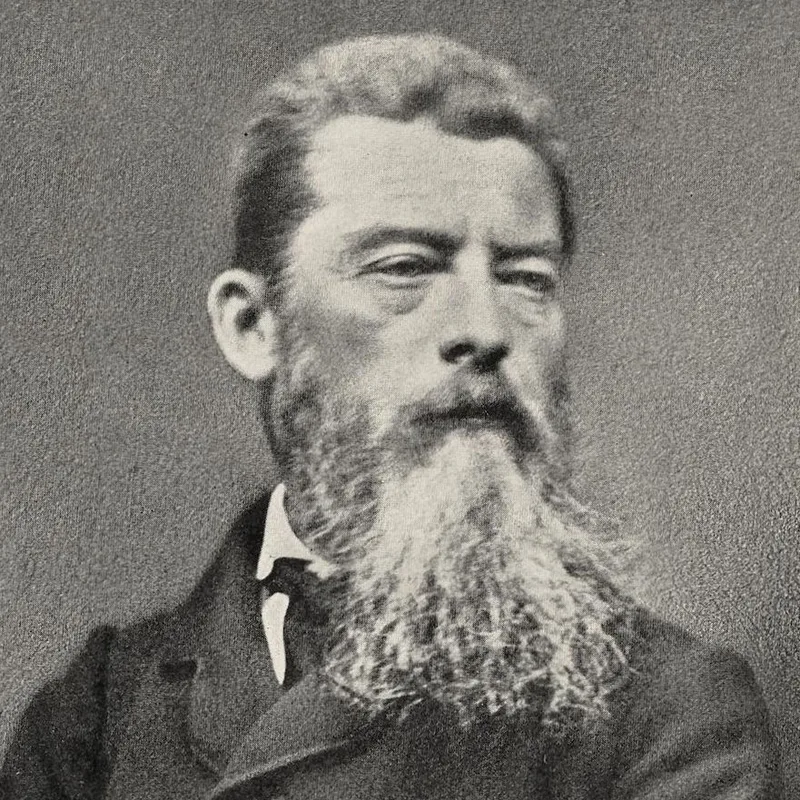
Ludwig Feuerbach
Philosopher, 1804–1872
Atheist humanist
What is the meaning of life?
The love of man for man is the highest law.
Feuerbach studied theology and then philosophy under Hegel in Berlin, and lost his chance of a university career when his anonymous Thoughts on Death and Immortality (1830), which denied personal immortality, was traced to him. In The Essence of Christianity (1841) he argued that everything people had given to God, love, wisdom, justice and goodness, belonged in truth to human beings, and that the task was to take it back. If human nature is the highest nature, then the highest law is the love of one human being for another: homo homini deus est, man is God to man. Friendship, marriage and the bond of parent and child were for him already sacred, without a priest to bless them.
-
“If human nature is the highest nature to man, then practically also the highest and first law must be the love of man to man. Homo homini Deus est:—this is the great practical principle:—this is the axis on which revolves the history of the world.”1
-
“The relations of child and parent, of husband and wife, of brother and friend—in general, of man to man—in short, all the moral relations are per se religious.”1
What is the meaning of the universe?
God is the mirror of man; theology is really anthropology.
Feuerbach did not think religion was simply false; he thought it was misunderstood, above all by believers. When people worship God they are worshipping, without knowing it, the best of their own human nature, projected outside themselves and set over them as another being. Religion is the dream of the human mind, he wrote, and his work was to wake it: the secret of theology is anthropology. The book was translated into English by George Eliot in 1854, and it shaped the critique of religion of Marx and Engels.
-
“Religion is the dream of the human mind. But even in dreams we do not find ourselves in emptiness or in heaven, but on earth, in the realm of reality; we only see real things in the entrancing splendour of imagination and caprice, instead of in the simple daylight of reality and necessity.”2
-
“God is the mirror of man. That which has essential value for man, which he esteems the perfect, the excellent, in which he has true delight,—that alone is God to him.”3
-
“We have shown that the substance and object of religion is altogether human; we have shown that divine wisdom is human wisdom; that the secret of theology is anthropology…”1