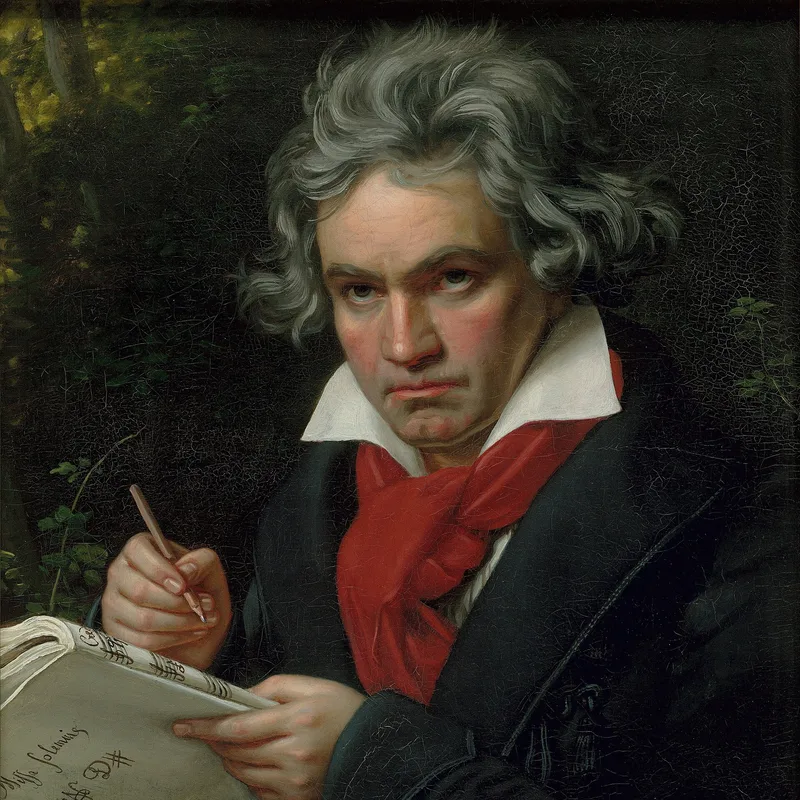
Ludwig van Beethoven
Composer, Pianist, 1770–1827
Theist
What is the meaning of life?
To serve suffering humanity through art, and win joy through sorrow.
Beethoven's answer was shaped by his deafness. In the Heiligenstadt Testament of 1802, a letter to his brothers that he never sent, he says he came close to suicide and that only his art held him back: it seemed impossible to leave the world before he had brought out everything he felt called to produce. He adds that virtue, not money, is what makes a person happy. Later letters put the same purpose in religious terms — his art existed to serve suffering humanity, and the artist's task was to come nearer to God than other men and pass the light on. The bargain he made with his fate, joy reached through suffering, is the one he recommended to his friends.
-
“recommend virtue to your children, it alone can give happiness, not money, I speak from experience, it was virtue that upheld me in misery, to it next to my art I owe the fact that I did not end my life with suicide.”1
-
“We finite ones with infinite souls are born only for sorrows and joy and it might almost be said that the best of us receive joy through sorrow.”2
-
“Nothing can be more sublime than to draw nearer to the Godhead than other men, and to diffuse here on earth these godlike rays among mortals.”3
What is the meaning of the universe?
A personal God, nearest in the woods, who sees into the heart.
Beethoven was baptised a Catholic and received the last rites, but his faith was his own rather than the Church's; the religion of the Bonn court where he grew up was an Enlightenment compromise between Church and reason. His letters speak of God and Providence as a person who reads his heart and will one day set his affairs right. He felt that presence most in nature: a note he wrote on music paper on the Kahlenberg addresses God directly, every tree speaking through him. His diary of 1812–1818 shows him reading widely — Hindu texts, Kant's starry sky and moral law, and an Egyptian temple inscription, "I am that which is", that he copied out and kept framed on his desk. None of it hardened into a creed, and the God of the Missa solemnis and the Ninth Symphony is a father beyond the stars, addressed from the heart.
-
“That Providence, who searches my inmost heart, and knows that as a man I have striven sacredly to fulfil all the duties imposed on me by humanity, God, and Nature, will no doubt one day extricate me from all these troubles.”4
-
“Almighty One / In the woods / I am blessed. / Happy every one / In the woods. / Every tree speaks / Through Thee. / O God! What glory / in the Woodland. / On the Heights is Peace, — / Peace to serve Him —”5
-
“O Providence — grant me at least but one day of pure joy — it is so long since real joy echoed in my heart — O when — O when, O Divine One — shall I find it again in the temple of nature and of men — Never? no — O that would be too hard.”6