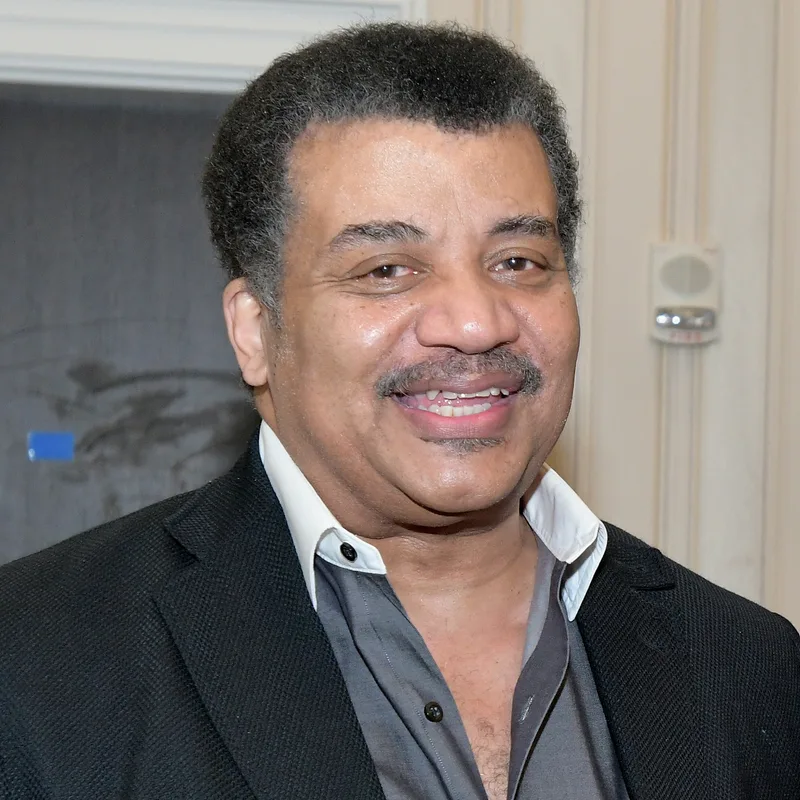
Neil deGrasse Tyson
Astrophysicist, Science communicator, born 1958
Agnostic
What is the meaning of life?
Meaning isn't found; you manufacture it — and lessen others' suffering.
Tyson does not think meaning is found; he thinks it is made. In a 2012 Reddit AMA he said that people who look for love, meaning or motivation as if they were hidden behind a tree or under a rock have it backwards: the most successful people create their own love, manufacture their own meaning and generate their own motivation. His own two philosophies were to know more about the world each day than the day before, and along the way to lessen the suffering of others. The astronomy he teaches supplies the rest. Because our atoms were forged in stars, he says he feels not small but connected, and he argues that the cosmic perspective, which shows a universe that was not built to nurture us, should make us value one another more.
-
“The problem, often not discovered until late in life, is that when you look for things like love, meaning, motivation, it implies they are sitting behind a tree or under a rock. The most successful people recognize, that in life they create their own love, they manufacture their own meaning, they generate their own motivation. For me, I am driven by two main philosophies, know more today about the world than I knew yesterday. And along the way, lessen the suffering of others.”1
-
“Many people feel small 'cause they're small and the Universe is big — but I feel big, 'cause my atoms came from those stars. There's a level of connectivity. That's really what you want in life, you want to feel connected, you want to feel relevant, you want to feel like a participant in the goings on of activities and events around you. That's precisely what we are, just by being alive.”2
-
“The cosmic perspective opens our eyes to the universe, not as a benevolent cradle designed to nurture life but as a cold, lonely, hazardous place, forcing us to reassess the value of all humans to one another.”3
What is the meaning of the universe?
The universe is in us, and owes us neither sense nor kindness.
Tyson's universe is the one physics describes: it had a beginning, it keeps evolving, and the atoms in our bodies were made inside stars that exploded billions of years ago, so that, in his phrase, the universe is in us. He calls the cosmic perspective spiritual, even redemptive, but not religious, and he does not find a benevolent designer behind it: a universe with so many ways to kill us is hard to reconcile with the beneficence religions ascribe to a higher power. He says he remains unconvinced by any claim of a divine force operating in the universe, yet he declines the label atheist; in a 2012 Big Think interview he said agnostic was the word that came closest, and that he would rather not be in any category at all. A line from Astrophysics for People in a Hurry (2017) sums up the attitude.
-
“The most astounding fact is the knowledge that the atoms that comprise life on Earth, the atoms that make up the human body, are traceable to the crucibles that cooked light elements into heavy elements in their core under extreme temperatures and pressures. … So that when I look up at the night sky and I know that yes, we are part of this universe, we are in this universe, but perhaps more important than both of those facts is that the Universe is in us.”2
-
“Every account of a higher power that I've seen described, of all religions that I've seen, include many statements with regard to the benevolence of that power. When I look at the universe and all the ways the universe wants to kill us, I find it hard to reconcile that with statements of beneficence.”4
-
“I remain unconvinced by any claims anyone has ever made about the existence or the power of a divine force operating in the universe.”5
-
“The universe is under no obligation to make sense to you.”6