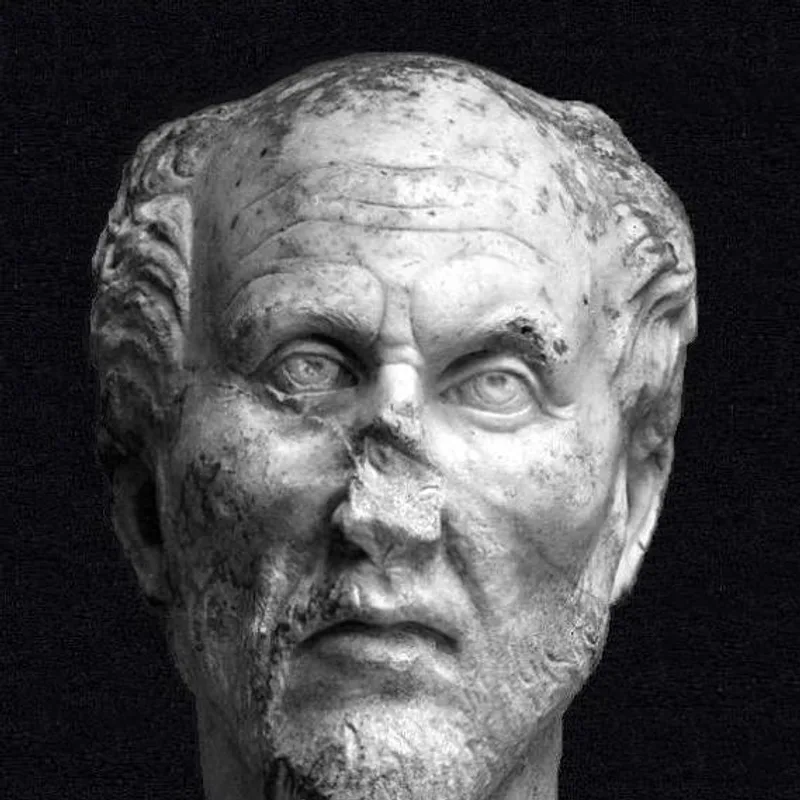
Plotinus
Philosopher, c. 204 – 270
Neoplatonist mystic
What is the meaning of life?
Never cease chiselling your statue until virtue shines out.
Plotinus, probably born in Egypt, studied for eleven years in Alexandria under the philosopher Ammonius Saccas, joined a Roman military expedition against Persia in the hope of learning the wisdom of the East, and then taught in Rome for a quarter of a century; his student Porphyry arranged his writings into six groups of nine treatises, the Enneads. For Plotinus the purpose of life is the soul's return to its source, and the way there is inward. Withdraw into yourself and look, he wrote, and if you do not yet find yourself beautiful, work on yourself as a sculptor works on a statue, cutting away what is excessive and straightening what is crooked, until the godlike splendour of virtue shines out. The journey ends in union, the passing of solitary to solitary.
-
“Withdraw into yourself and look. And if you do not find yourself beautiful yet, act as does the creator of a statue that is to be made beautiful: he cuts away here, he smoothes there, he makes this line lighter, this other purer… So do you also: cut away all that is excessive, straighten all that is crooked, bring light to all that is overcast, labour to make all one glow of beauty and never cease chiselling your statue, until there shall shine out on you from it the godlike splendour of virtue…”1
-
“This is the life of gods and of the godlike and blessed among men, liberation from the alien that besets us here, a life taking no pleasure in the things of earth, the passing of solitary to solitary.”2
What is the meaning of the universe?
Everything overflows from the One, which is all and none of them.
Plotinus's universe flows down from a single source he called the One, or the Good: absolutely simple, beyond being and beyond thought, so perfect that it overflows, and from its overflowing comes Intellect, from Intellect Soul, and from Soul the visible world, down to matter, the last and dimmest reflection of the light. The One is all things and no one of them, the source of everything that exists without being any of it, and nothing can be said of it that is not too little. Plotinus held that it could still be reached, not by reasoning but in moments of mystical union; Porphyry reported that his master attained it four times while he was with him.
-
“The One is all things and no one of them; the source of all things is not all things; all things are its possession—running back, so to speak, to it—or, more correctly, not yet so, they will be.”3
-
“Seeking nothing, possessing nothing, lacking nothing, the One is perfect and, in our metaphor, has overflowed, and its exuberance has produced the new…”3