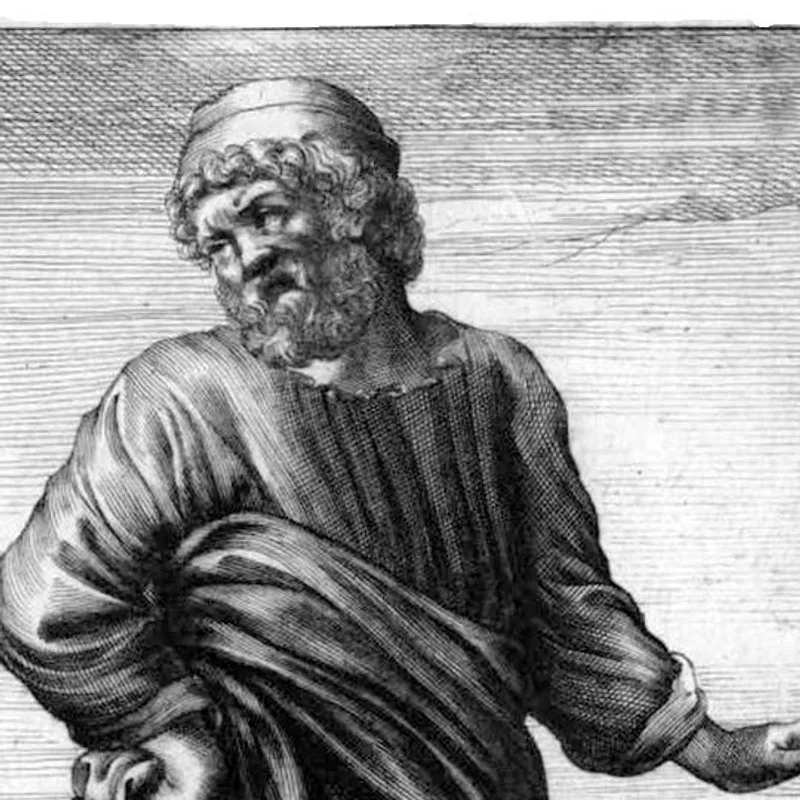
Pyrrho
Philosopher, c. 360 – c. 270 BC
Founder of Skepticism
What is the meaning of life?
Suspend judgement, and calm follows like a shadow.
Pyrrho of Elis was a painter before he turned to philosophy, and he travelled with Alexander the Great's army as far as India, where he is said to have met naked ascetics and Persian magi. He came back teaching that, since nothing can be known for certain, the wise suspend judgement, and peace of mind follows like a shadow. Diogenes Laërtius tells that during a storm at sea, when the other passengers panicked, Pyrrho pointed to a little pig on board that went on eating and said that the wise should stay just as unperturbed.
-
“When his fellow-passengers on board a ship were all unnerved by a storm, he kept calm and confident, pointing to a little pig in the ship that went on eating, and telling them that such was the unperturbed state in which the wise man should keep himself.”1
-
“The end to be realized they hold to be suspension of judgement, which brings with it tranquillity like its shadow…”2
What is the meaning of the universe?
Nothing is in itself any more this than that.
Pyrrho wrote nothing; his pupil Timon spread his teaching in satirical verse. In the account that survives, things are equally indifferent, unmeasurable and undecidable, so that neither our senses nor our opinions tell us the truth about them. He denied that anything was honourable or shameful, just or unjust in itself: custom and convention govern human action. His school, revived centuries later by Aenesidemus and Sextus Empiricus, made doubt a way of life rather than a conclusion, and Montaigne and Hume later drew on it.
-
“And so, universally, he held that there is nothing really existent, but custom and convention govern human action; for no single thing is in itself any more this than that.”3