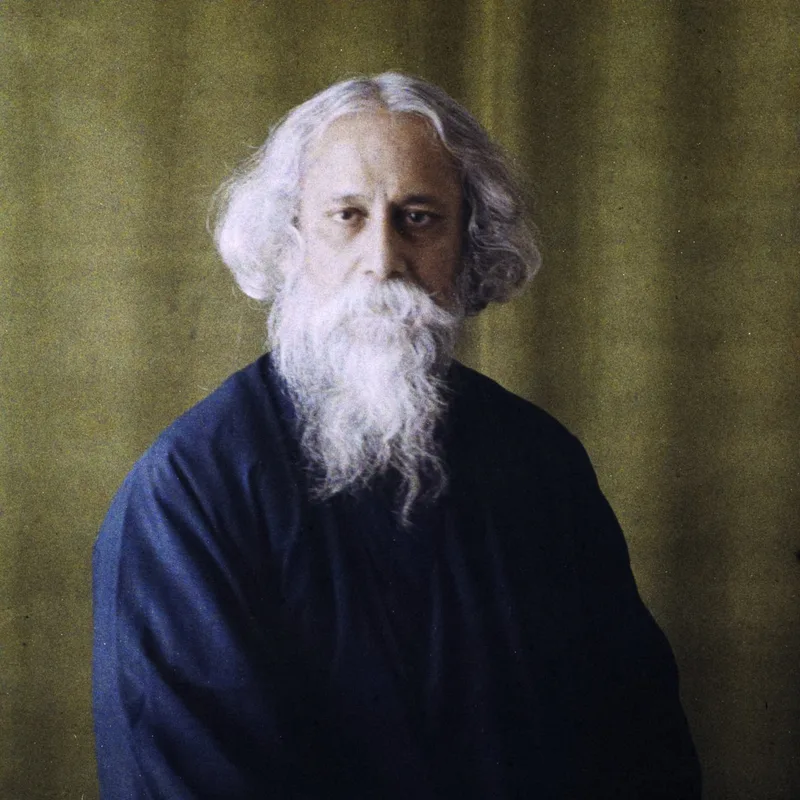
Rabindranath Tagore
Poet, Philosopher, Composer, 1861–1941
Upanishadic humanist
What is the meaning of life?
To move from law to love, and find God in work.
Tagore grew up in a household at the centre of the Brahmo reform movement, which his father Debendranath led, and he took his answer from the Upanishads, read, as he later put it, with a poet's religion rather than a theologian's. In Sadhana (1913), papers drawn from his talks to students at his school at Bolpur and read at Harvard, he describes life as a journey from law to love: an infinite joy takes on the bonds of law in finite forms, and we fulfil our destiny by going back from law to love. He would not separate this from ordinary work. The joy of life and the joy of work are true, he wrote, and the infinite is not realised apart from the world of action. In Gitanjali (1912) he tells the worshipper to leave the closed temple, because God is out with the farmer tilling hard ground and the road-maker breaking stones.
-
“The infinite joy is manifesting itself in manifold forms, taking upon itself the bondage of law, and we fulfil our destiny when we go back from forms to joy, from law to the love, when we untie the knot of the finite and hark back to the infinite. The human soul is on its journey from the law to love, from discipline to liberation, from the moral plane to the spiritual.”1
-
“This joy of life, this joy of work, in man is absolutely true. It is no use saying that it is a delusion of ours; that unless we cast it away we cannot enter upon the path of self-realisation. It will never do the least good to attempt the realisation of the infinite apart from the world of action.”2
-
“Leave this chanting and singing and telling of beads! Whom dost thou worship in this lonely dark corner of a temple with doors all shut? Open thine eyes and see thy God is not before thee! He is there where the tiller is tilling the hard ground and where the pathmaker is breaking stones. He is with them in sun and in shower, and his garment is covered with dust. … Meet him and stand by him in toil and in sweat of thy brow.”3
What is the meaning of the universe?
Joy and love at the root of creation, one life in all.
For Tagore the universe is the expression of an infinite being whose nature is joy and love. In Sadhana he calls love the ultimate meaning of everything around us, the joy at the root of all creation, and in Gitanjali he feels the same stream of life in his own veins as in the grass, the leaves and the tides of birth and death. He did not set the divine apart from the world or from people. When Albert Einstein asked him at Kaputh, near Berlin, in July 1930 whether he believed in the Divine as isolated from the world, he answered that the infinite personality of Man comprehends the universe, so that its truth is human truth; Einstein, who believed truth holds independently of humanity, admitted he could not prove it and called that his religion. Tagore met death in the same spirit: having loved this life, he expected to love death as well.
-
“For love is the ultimate meaning of everything around us. It is not a mere sentiment; it is truth; it is the joy that is at the root of all creation. It is the white light of pure consciousness that emanates from Brahma.”1
-
“The same stream of life that runs through my veins night and day runs through the world and dances in rhythmic measures. It is the same life that shoots in joy through the dust of the earth in numberless blades of grass and breaks into tumultuous waves of leaves and flowers. It is the same life that is rocked in the ocean-cradle of birth and of death, in ebb and in flow.”4
-
“Not isolated. The infinite personality of Man comprehends the Universe. There cannot be anything that cannot be subsumed by the human personality, and this proves that the truth of the Universe is human truth.”5
-
“When in the morning I looked upon the light I felt in a moment that I was no stranger in this world, that the inscrutable without name and form had taken me in its arms in the form of my own mother. Even so, in death the same unknown will appear as ever known to me. And because I love this life, I know I shall love death as well.”6