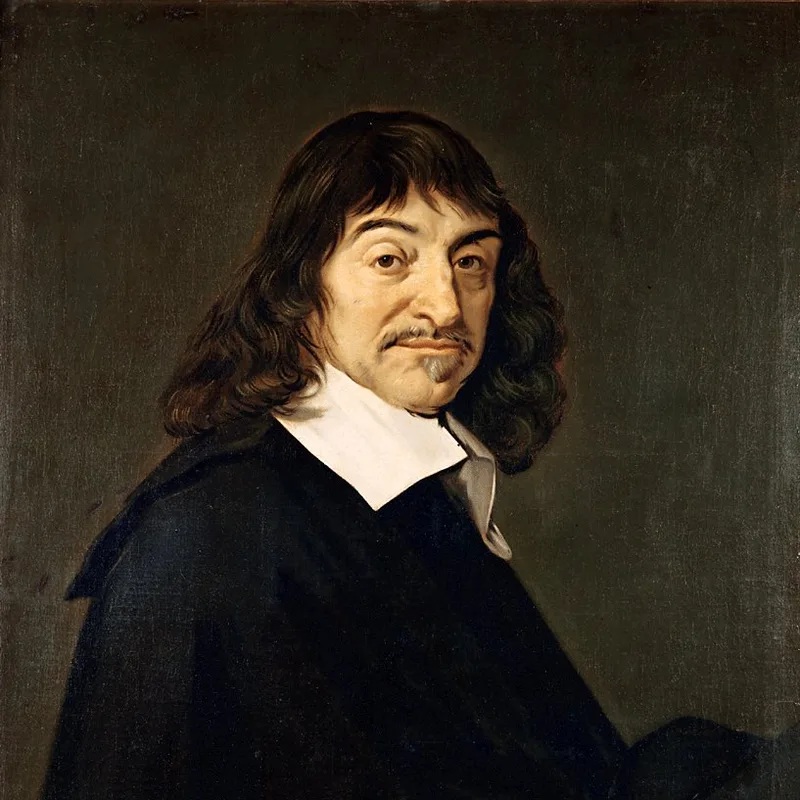
René Descartes
Philosopher, Mathematician, Scientist, 1596–1650
Catholic rationalist
What is the meaning of life?
Master yourself, not fortune, and spend your life cultivating reason.
Descartes set out his rules for living in Part III of the Discourse on Method (1637) as a provisional moral code, a house to live in while his method of doubt was rebuilding everything else: obey the laws and customs of his country and keep the faith he was raised in, act firmly once he had decided, master himself rather than fortune, and devote his life to cultivating his reason. Since nothing is fully in our power except our thoughts, contentment comes from wanting only what depends on us. He returned to these rules in 1645, in letters to Princess Elisabeth of Bohemia about Seneca's treatise on the happy life, where he described the supreme good we can possess as a firm will to do what we judge best, and happiness as the contentment of mind that follows from it. In the 1647 preface to the French translation of the Principles of Philosophy he named the supreme good that reason can see without faith as wisdom: knowing truth through its first causes.
-
“My third maxim was to endeavor always to conquer myself rather than fortune, and change my desires rather than the order of the world, and in general, accustom myself to the persuasion that, except our own thoughts, there is nothing absolutely in our power.”1
-
“It was my conviction that I could not do better than continue in that in which I was engaged, viz., in devoting my whole life to the culture of my reason, and in making the greatest progress I was able in the knowledge of truth, on the principles of the method which I had prescribed to myself.”1
-
“It seems to me that each person can make himself content by himself, without expecting anything from elsewhere, provided only that he observes three things, to which the three rules of morals, which I have set forth in the Discourse on the Method, relate.”2
-
“The supreme good, considered by natural reason without the light of faith, is nothing more than the knowledge of truth through its first causes, in other words, the wisdom of which philosophy is the study.”3
What is the meaning of the universe?
A perfect God, proved by reason; mind and matter, two substances.
Descartes rebuilt knowledge from the one thing his doubt could not touch — that he was thinking — and then argued his way to God. In the Meditations (1641) the idea of an infinite, perfect being could not have come from a finite mind, so God must exist and have placed it in him, like a maker's mark on his work; and because God is no deceiver, he guarantees that what we perceive clearly and distinctly is true. The created world consists of two kinds of substance: minds, which think and have no extension, and bodies, which are extended and do not think. Matter, the human body included, runs by laws of nature that he derived from God's perfection alone and that would hold in any world God might have made.
-
“By the name God, I understand a substance infinite, [eternal, immutable], independent, all-knowing, all-powerful, and by which I myself, and every other thing that exists, if any such there be, were created. … And thus it is absolutely necessary to conclude, from all that I have before said, that God exists.”4
-
“And thus I very clearly see that the certitude and truth of all science depends on the knowledge alone of the true God, insomuch that, before I knew him, I could have no perfect knowledge of any other thing.”5
-
“Because, on the one hand, I have a clear and distinct idea of myself, in as far as I am only a thinking and unextended thing, and as, on the other hand, I possess a distinct idea of body, in as far as it is only an extended and unthinking thing, it is certain that I, [that is, my mind, by which I am what I am], is entirely and truly distinct from my body, and may exist without it.”6
-
“I have pointed out what are the laws of nature; and, with no other principle upon which to found my reasonings except the infinite perfection of God, I endeavored to demonstrate all those about which there could be any room for doubt, and to prove that they are such, that even if God had created more worlds, there could have been none in which these laws were not observed.”7