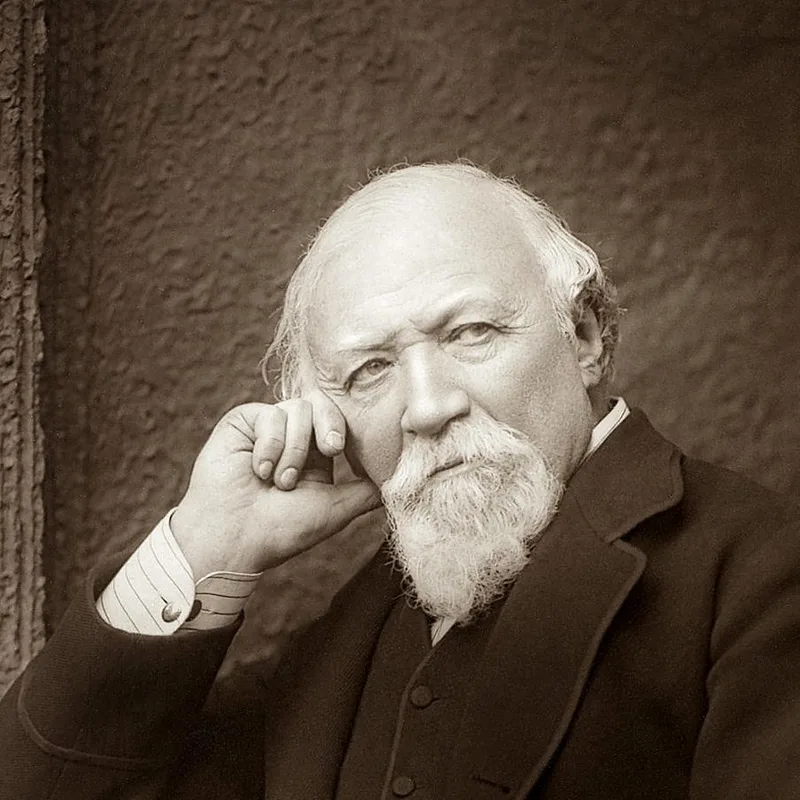
Robert Browning
Poet, 1812–1889
Robust Christian optimist
What is the meaning of life?
A man's reach should exceed his grasp; we fall to rise.
Browning was largely self-educated in his father's library of six thousand books, struggled for decades to find readers, and became famous only in his fifties; his secret courtship of the poet Elizabeth Barrett and their elopement to Italy in 1846 became one of the great love stories of literature. He perfected the dramatic monologue, poems spoken by vivid characters, painters, bishops, murderers, whose words reveal more than they mean to. His own spirit was strenuous and hopeful. In the Epilogue to his last book, published on the day he died, he described himself as one who never turned his back but marched breast forward, who held that we fall to rise and are baffled to fight better.
-
“One who never turned his back but marched breast forward, / Never doubted clouds would break, / Never dreamed, though right were worsted, wrong would triumph, / Held we fall to rise, are baffled to fight better, / Sleep to wake.”1
-
“Ah, but a man's reach should exceed his grasp, / Or what's a heaven for?”2
What is the meaning of the universe?
Trust God: youth shows but half; the best is yet to be.
Browning remained a Christian of a robust, undogmatic kind all his life, and many of his poems wrestle with doubt and evolution in the age of Darwin before coming down on the side of hope. His most-quoted statement of faith is put into the mouth of a twelfth-century Jewish scholar, Rabbi Ben Ezra, who welcomes old age as the fulfilment for which youth was made: our times are in God's hand, who planned a whole of which youth shows only half, so trust God, see all, and do not be afraid. After Elizabeth's death in Florence in 1861 he returned to these questions in The Ring and the Book, a vast poem about a Roman murder trial in which an aged Pope weighs evil against providence.
-
“Grow old along with me! / The best is yet to be, / The last of life, for which the first was made: / Our times are in his hand / Who saith, "A whole I planned, / Youth shows but half; trust God: see all, nor be afraid!"”3