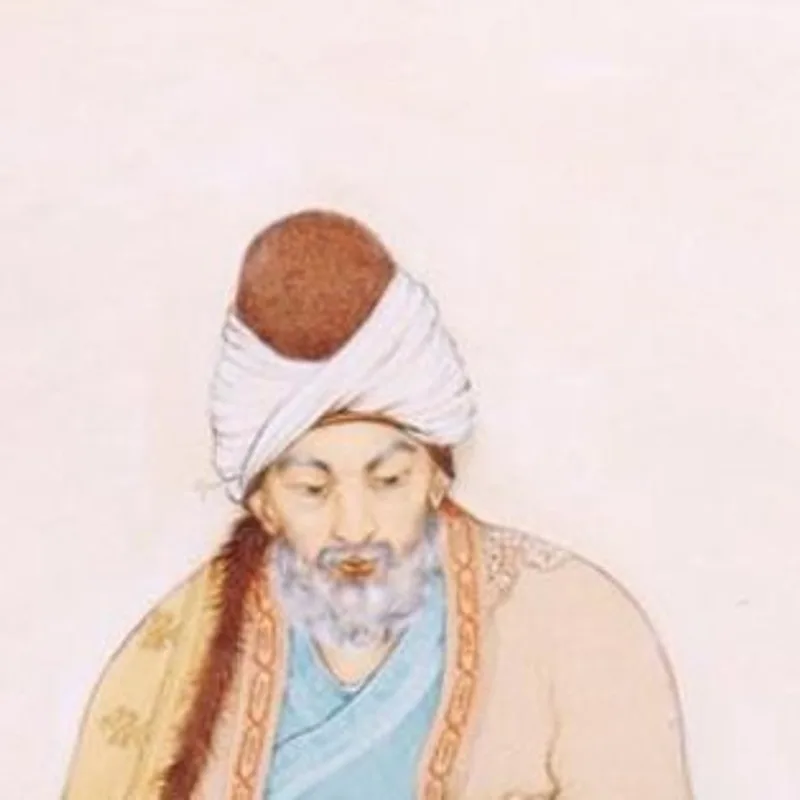
Rumi
Poet, Sufi mystic, Islamic scholar, 1207–1273
Sufi
What is the meaning of life?
To return, through love, to the source you were cut from.
Rumi's answer is love, and love is homesickness. The Masnavi, the long poem he dictated in Konya in the last decades of his life, opens with a reed flute torn from its reed-bed and lamenting its banishment: whoever is far from home longs for the day of return. That longing, not reason, is what drives a human life, and it is answered by losing the self — selling cleverness for bewilderment, burning away the self in the fire of love. He had been a jurist and preacher; the turning point was his meeting with the wandering dervish Shams of Tabriz in 1244, whose disappearance left Rumi addressing God and the lost friend in the same breath. Death, in this scheme, is not an end but a step up a ladder: mineral, plant, animal, man, angel, and then what no mind can conceive.
-
“Hearken to the reed-flute, how it complains, Lamenting its banishment from its home: "Ever since they tore me from my osier bed, My plaintive notes have moved men and women to tears. I burst my breast, striving to give vent to sighs, And to express the pangs of my yearning for my home. He who abides far away from his home Is ever longing for the day he shall return."”1
-
“I died as a mineral and became a plant, I died as plant and rose to animal, I died as animal and I was Man. Why should I fear? When was I less by dying? Yet once more I shall die as Man, to soar With angels blest; but even from angelhood I must pass on: all except God doth perish. When I have sacrificed my angel-soul, I shall become what no mind e'er conceived. Oh, let me not exist! for Non-existence Proclaims in organ tones, 'To Him we shall return.'”2
-
“Love is the ark appointed for the righteous, Which annuls the danger and provides a way of escape. Sell your cleverness and buy bewilderment. Cleverness is mere opinion, bewilderment intuition.”3
-
“If you wish to shine like day, burn up the night of self-existence. Dissolve in the Being who is everything.”4
What is the meaning of the universe?
There is no being but God's — the rest is foam.
Rumi was an orthodox Muslim scholar, and his universe is God's: he called the Masnavi an explainer of the Qur'an, and the Qur'anic line that everything perishes except God's face runs through his verse. But he reads it as a mystic. The visible world is foam on a sea, and most people watch the foam; reason is a shadow and God the sun; creation is renewed every instant, so that what looks solid and continuous is a flicker of divine action, like a spark whirled round so fast it looks like a line of fire. He defended al-Hallaj's execution-earning cry 'I am God' as the extreme of humility: the one who says it has made himself nothing, so that only God is left. The lamps differ, he said of the religions, but the light is the same.
-
“The man who says Ana 'l-'abd, "I am the servant of God" affirms two existences, his own and God's, but he that says Anā l-Ḥaqq, "I am God" has made himself non-existent and has given himself up and says "I am God", that is, "I am naught, He is all; there is no being but God's." This is the extreme of humility and self-abasement.”5
-
“The eye of outward sense is as the palm of a hand, The whole of the object is not grasped in the palm. The sea itself is one thing, the foam another; Neglect the foam, and regard the sea with your eyes.”6
-
“Every moment the world and we are renewed, Yet we are ignorant of this renewing forever and aye. Life, like a stream of water, is renewed and renewed, Though it wears the appearance of continuity in form.”7
-
“Reason is like an officer when the King appears; The officer then loses his power and hides himself. Reason is the shadow cast by God; God is the sun.”3