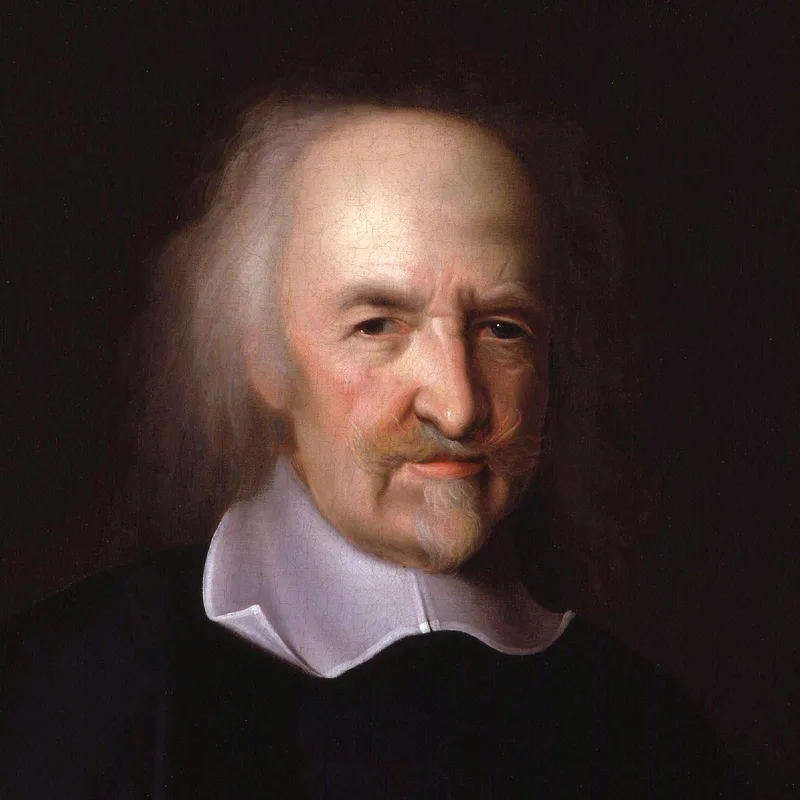
Thomas Hobbes
Philosopher, 1588–1679
Materialist Christian
What is the meaning of life?
There is no final goal; happiness is desire moving ever onward.
Hobbes lived through the English Civil War and wrote Leviathan (1651) to show why people need a strong sovereign: without one, life would be a war of all against all, solitary, poor, nasty, brutish and short. On the good life he broke with the ancient philosophers. There is no final end or greatest good in which a mind can come to rest, he argued; a man whose desires were at an end could no more live than one whose senses had stopped. Happiness is continual progress from one desire to the next, and he saw in all mankind a restless desire of power after power that ends only in death.
-
“…the Felicity of this life, consisteth not in the repose of a mind satisfied. For there is no such Finis Ultimus, (utmost ayme,) nor Summum Bonum, (greatest good,) as is spoken of in the Books of the old Morall Philosophers. … Felicity is a continuall progresse of the desire, from one object to another; the attaining of the former, being still but the way to the later.”1
-
“So that in the first place, I put for a generall inclination of all mankind, a perpetuall and restlesse desire of Power after power, that ceaseth onely in Death.”1
What is the meaning of the universe?
Everything real is body; God is the first, eternal cause.
Hobbes was a thoroughgoing materialist: the universe is body, and whatever is not body is nothing at all, so that even spirits, and God, must be bodies of some subtle kind. He nonetheless professed to be a Christian, and argued that anyone who follows causes back far enough must come to a first and eternal cause, which is what people mean by God. Of God's nature, he held, we can understand nothing except that God exists. Many readers in his own time suspected him of atheism, and after the Great Fire of London a committee of Parliament examined Leviathan for blasphemy.
-
“For he that from any effect hee seeth come to passe, should reason to the next and immediate cause thereof, and from thence to the cause of that cause, and plonge himselfe profoundly in the pursuit of causes; shall at last come to this, that there must be (as even the Heathen Philosophers confessed) one First Mover; that is, a First, and an Eternall cause of all things; which is that which men mean by the name of God…”2
-
“The World, (I mean not the Earth onely, that denominates the Lovers of it Worldly Men, but the Universe, that is, the whole masse of all things that are) is Corporeall, that is to say, Body; … and consequently every part of the Universe, is Body, and that which is not Body, is no part of the Universe: And because the Universe is all, that which is no part of it, is Nothing; and consequently No Where.”3