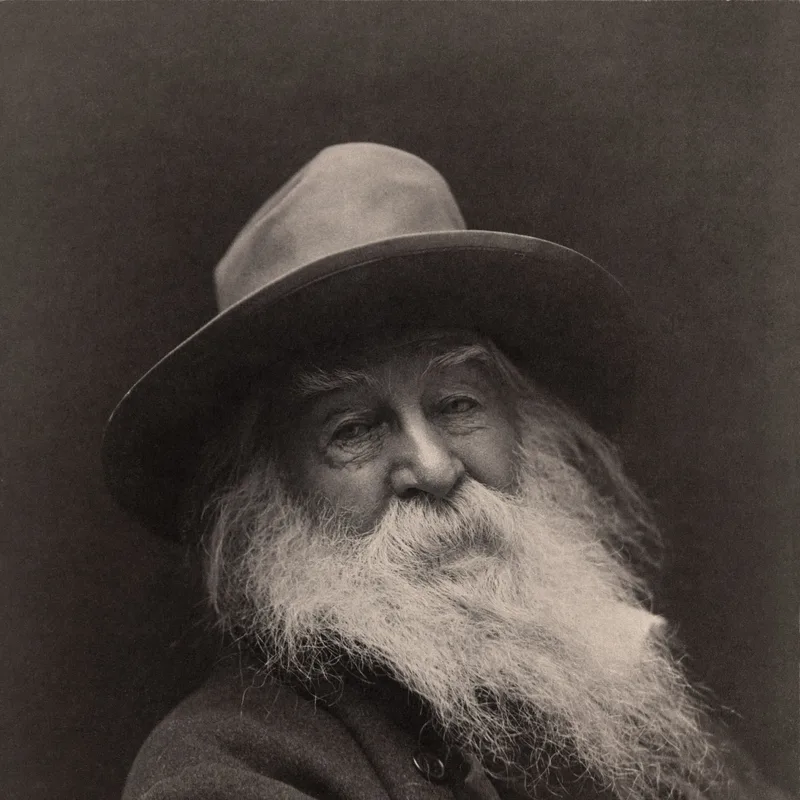
Walt Whitman
Poet, Essayist, Journalist, 1819–1892
Pantheist
What is the meaning of life?
You are here, the powerful play goes on: contribute a verse.
Whitman spent his life rewriting one book, Leaves of Grass, from its first, self-published edition of 1855 to the deathbed edition of 1892. Its answer to what life is for is given in the book's own voice: to be here at all, to take part, to love the earth and people, to give freely and to bow to no one. In the short poem O Me! O Life! he asks what good there is amid the empty years and answers with the plain fact of existing. During the Civil War he spent years visiting wounded soldiers in the hospitals of Washington.
-
“Answer. / That you are here—that life exists and identity, / That the powerful play goes on, and you may contribute a verse.”1
-
“This is what you shall do: Love the earth and sun and the animals, despise riches, give alms to every one that asks, stand up for the stupid and crazy, devote your income and labor to others, hate tyrants, argue not concerning God, have patience and indulgence toward the people, take off your hat to nothing known or unknown…”2
What is the meaning of the universe?
God in every object, every leaf of grass the work of stars.
Whitman's universe is one in which everything is equally divine: a blade of grass, an ant, a grain of sand, his own body. He grew up partly among Quakers and belonged to no church, and in Song of Myself he says he is curious about everything except God, about whom he is at peace. He sees God in every object and every face without claiming to understand him. Death, in the poem, is not an end but a passing back into the whole, and luckier than anyone supposed.
-
“I hear and behold God in every object, yet understand God not in the least, / Nor do I understand who there can be more wonderful than myself.”3
-
“I believe a leaf of grass is no less than the journey work of the stars, / And the pismire is equally perfect, and a grain of sand, and the egg of the wren”4
-
“I find letters from God dropt in the street, and every one is sign'd by God's name, / And I leave them where they are, for I know that wheresoe'er I go, / Others will punctually come for ever and ever.”3