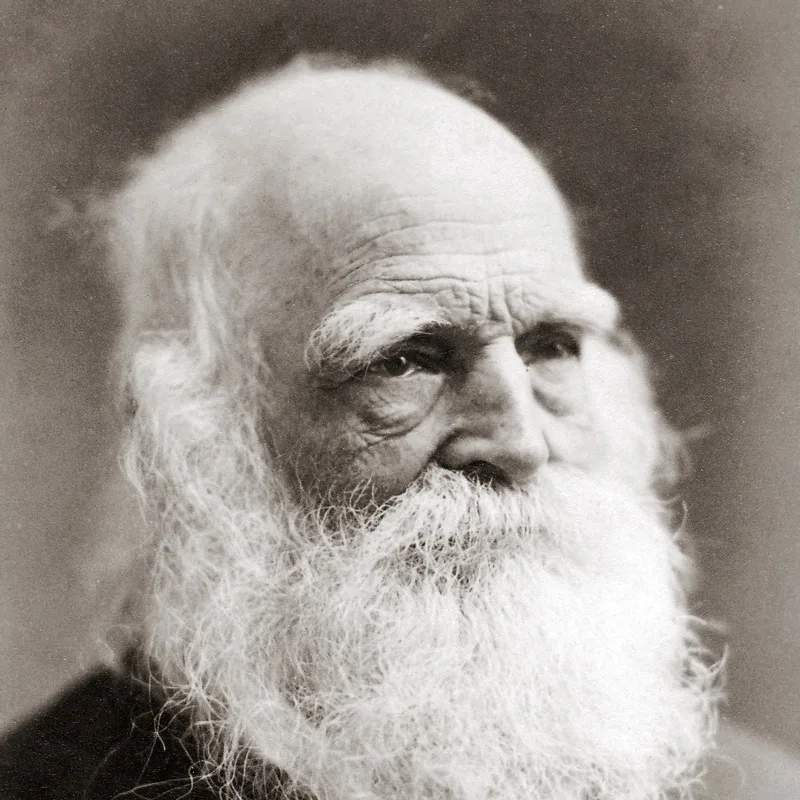
William Cullen Bryant
Poet, Editor, 1794–1878
Poet of nature and providence
What is the meaning of life?
So live that you can meet death with unfaltering trust.
Bryant drafted Thanatopsis, a meditation on death, as a teenager in rural Massachusetts, and its publication in 1817 made him the first widely admired American poet. He then spent half a century as editor of the New York Evening Post, campaigning against slavery and for the creation of Central Park. The poem's answer to death is calm rather than fear: nature receives all the dead alike, so live in such a way that when your summons comes you can approach the grave sustained by an unfaltering trust, like someone lying down to pleasant dreams.
-
“So live, that when thy summons comes to join / The innumerable caravan which moves / To that mysterious realm, where each shall take / His chamber in the silent halls of death, / Thou go not, like the quarry-slave at night, / Scourged to his dungeon, but, sustained and soothed / By an unfaltering trust, approach thy grave / Like one who wraps the drapery of his couch / About him, and lies down to pleasant dreams”1
What is the meaning of the universe?
The one who guides the bird's flight will guide my steps.
Bryant was raised a Calvinist and became a Unitarian, and his poetry finds God less in doctrine than in the order of nature. In To a Waterfowl (1818), written as he walked to an uncertain future as a young lawyer, he watches a lone bird crossing the evening sky and reflects that a Power guides it along the pathless coast; the same guide, he concludes, will lead his own steps aright. In A Forest Hymn (1825) he wrote that the groves were God's first temples, where a worshipper can feel his presence more directly than in any church built by hands.
-
“He who, from zone to zone, / Guides through the boundless sky thy certain flight, / In the long way that I must tread alone, / Will lead my steps aright.”2